TOP UPDATES FOUR PILLARS CINEMA/TV GAMES MANGA/ANIME MUSIC WRITINGS FAQ LINKS
TOP UPDATES FOUR PILLARS CINEMA/TV GAMES MANGA/ANIME MUSIC WRITINGS FAQ LINKS
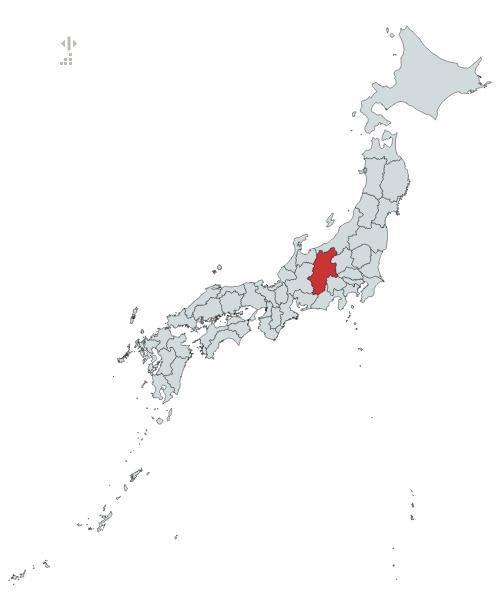
Nagano Prefecture is one of my favorite regions of Japan. It is an inland prefecture with a lot of mountains, which has historically allowed it to remain isolated from other parts of the country. In fact, the point in Japan furthest from the ocean is in Nagano Prefecture (it is in 佐久市・Saku-shi). The Prefecture is the 4th-largest in terms of space. There is a difference in culture and land even within the Prefecture. The larger cities and tourist spots are primarily in the northern half while the south is more rural, but the whole prefecture is pretty quiet and slow-paced (and let's keep it that way, please be cool if you decide to visit, readers). The topography is full of tall mountains. 6 of Japan's 10 highest mountains are in Nagano! If you visit, I recommend having an international license or someone else to drive you, as Nagano doesn't have the best public transportation.
Nagano has a very nice climate in my opinion. Spring is temperate. You can hear lots of croaking frogs. Summers are comparatively less humid due to high altitude, but unfortunately Nagano is warming up due to the greenhouse gas emissions of fossil fuels, just like everywhere else on earth. Autumn is full of dragonflies. The brightest red autumn leaves I remember seeing anywhere were around 蓼科湖 (Lake Tateshina). Winters aren't what they used to be, but they are still cold and snowy with good regularity, especially in the north and at higher altitudes. Being inland generally spares Nagano from the worst of the worst when it comes to characteristic disasters of Japan like typhoons, flooding, and tsunami. But mudslides can be a big problem, especially in the autumn with heavy rains and the spring with snowpack melt.
Animals and plants that are symbolic of the prefecture include the 雷鳥 (rock ptarmigan), カモシカ (Japanese serow), リンドウ (gentian), and カバノキ (birch).
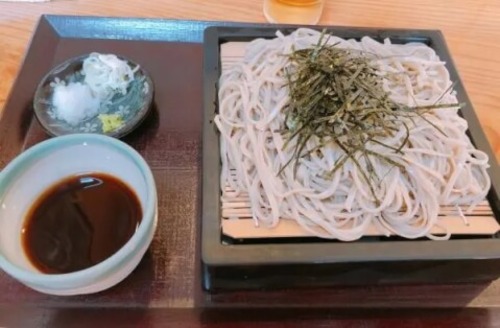
Nagano's harsh, mountainous climate is reflected in its culture of simple and frugal foodstuffs. I've actually found that Nagano is a surprisingly easy place for vegetarians to get by in the often very meat-centric Japan. The most characteristic food of Nagano Prefecture is 蕎麦 (soba). Another typical food is おやき (oyaki), which is a flour bun stuffed with savory ingredients, usually some kind of leafy greens or mushrooms. One of its unusual traditional meals is いなごの佃煮 (inago no tsukudani), or grasshoppers boiled in soy sauce and sugar. Insects as a food source are much easier in a Prefecture where farmable land is more scarce, and it has a doubly beneficial effect of reducing the population of locusts and thus the danger of their swarms. Another traditional food is salted slices of squid in salad. As Nagano is so removed from the ocean, traditionally when squid was brought by traders it would have to be preserved in salt. So the tradition of salted squid has stuck. I have tried it there and it was incredibly tasty. I sometimes make it as a part of my meals in the states.
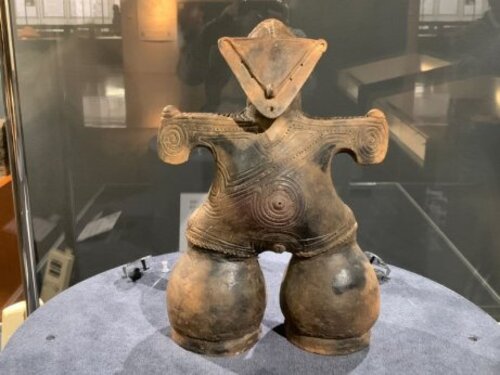
Nagano was the site of a large-scale Joumon period settlement called 尖石 (Togariishi). It is located in the modern-day city of 茅野市 (Chino-shi). Two doguu from the area have been designated as National Treasures. One is the 縄文のビーナス (Joumon Venus), which is rare in having all its limbs intact. It seems to depict a pregnant woman with its distended belly. The other is called the 仮面の女神 (masked goddess), which depicts a figure wearing a kind of triangular mask.
Nagano is an interesting place because it has been isolated enough that we have what seems like a hint to how Japanese religion was in a very primordial state, relatively untouched by continental religions like Buddhism and even by native attempts to unify Japan as a monolithic country. We especially see this around the 諏訪湖 (Lake Suwa) area. The Suwa region's distinctive indigenous faith is represented in a particularly rich and creative fashion in the game Touhou Fuujinroku 〜 Mountain of Faith, whose creator ZUN is a Nagano native. Most of the mythology in Nagano reads like layers on layers of myths, built on possibly distinct folkloric traditions that have blended and intersected in complex ways. It makes it one of the richest and most alluring places to study Japanese folklore.
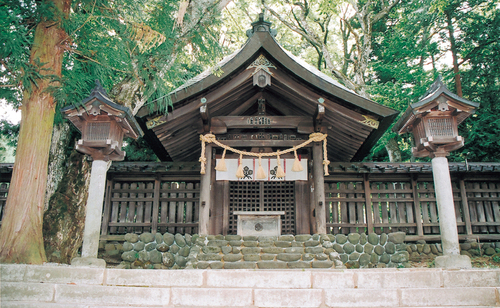
諏訪大社 (Suwa Taisha) is one of the oldest and most sacred shrines in Japan. It is
spoken of in the Nihon Shoki as already existing in the 5th year of 持統天皇
(Empress Jitou), meaning 691 AD. The complex that makes up Suwa Taisha is enormous and
is spread over multiple small cities around Lake Suwa. It is divided into two major
parts:
上社 (kamisha) or Upper Shrine. Further divided into 前宮 (maemiya, Former Shrine)
and 本宮 (honmiya, Main Shrine).
下社 (shimosha) or Lower Shrine. Further divided into 春宮 (harumiya, Spring
Shrine) and 秋宮 (akimiya, Autumn Shrine).
The Upper and Lower shrines seem to have originally been separate entities. They
are located on opposite sides of Lake Suwa. But they have become joined over the
years. Most of our historical knowledge comes from the Upper Shrine.
So now we must ask: What kami is enshrined at this shrine? The kami in question is Takeminakata-no-Kami. He is often referred to with the epithet Suwa Myoujin (Great Kami of Suwa) instead. Takeminakata is a kami of wind, water, and agriculture as well as hunting and warfare. For a more thorough treatment on his place in the Japanese mythological canon, see my entry on SHINTOU.
To give a summary of the Kojiki account: When the kami in Takamagahara wished to take control of Japan and subdue the unruly kami, the kami Takemikadzuchi was sent down to force the kami of Idzumo, Ookuninushi, to relinquish control. Ookuninushi deferred to his two sons Kotoshironushi and Takeminakata for their decision. Kotoshironushi believed that it was right to obey the decree of the kami above. Takeminakata refused and challenged Takemikadzuchi to a test of strength. Some have read this as the origin of sumou wrestling. For that reason, Suwa Taisha has a statue of a sumou wrestler in it and is connected with imagery of strength and valor.
In any case, Takeminakata is defeated and runs from Idzumo (modern-day Shimane Prefecture) to Lake Suwa before relinquishing control. Takeminakata is, however, granted a magnificent residence, which has come to be known as the Upper Shrine of Suwa Taisha. The Lower Shrine is the residence of his consort Yasakatome-no-Kami. This female kami is not as well-accounted in myth and is more mysterious, possibly being more connected to indigenous worship in the area.
(And yes, Yasaka Kanako from Touhou Project is based on Yasakatome. In fact, the Moriya Shrine in Touhou is modelled on Suwa Taisha. There is an actual Moriya Shrine in the city of Okaya, but it is very tiny and doesn't look like the one in Touhou.)
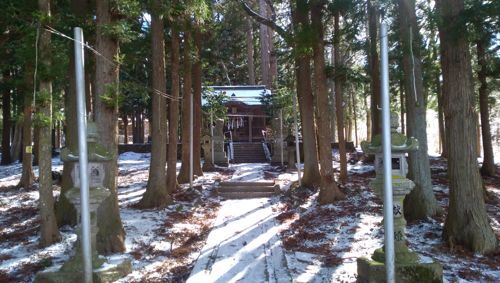
The Kojiki story essentially casts Takeminakata as a loser, which is never a particularly attractive story for the founder of a shrine. Here we get a glimpse of something that makes Nagano folklore so elusive but also fascinating: We get the sense that we might be looking at a number of different folklore traditions that have been amalgamated together. If you look at these stories in the right way, they start to bend and curve and reveal something that could be quite distinct from the "official" story of Japanese mythology and tradition. As an example, let's take an alternate story about the founding of Suwa Taisha. In this local mythology, Takeminakata is referred to as Suwa Myoujin (the great kami of Suwa). We might even think that Suwa Myoujin was originally a separate mythological figure who was identified with Takeminakata later.
In this founding, Suwa Myoujin arrives not as a loser but as a conqueror. This story recounts Suwa Myoujin as descending from Takamagahara in the land now known as Suwa, which was at that time ruled by a local deity called Moriya (originally written as Moreya). The two competed in a kind of tug-of-war using some kind of hooks or rings (鈎, kagi). Suwa Myoujin uses a hook made out of a wisteria plant which defeats Moriya who used a hook made out of iron. Some locate this fight as happening in the vicinity of the Upper Shrine. Others locate it on the banks of the Tenryuu River. Suwa Myoujin then builds the Upper Shrine over Moriya's land and plants the wisteria hook, which turns into a forest. This is a reversal of the Kojiki myth. Instead of Takeminakata being an earthly god deafeated by a heavenly one, Suwa Myoujin is a heavenly god who defeats an earthly one. Of course, many have interpreted this myth as a kind of mythologized recounting of the conquest of an earlier people by the Yamato state. Perhaps we even see the history of a Yayoi conquest of the Joumon natives reflected here.
(And yes, Moriya Suwako from Touhou Project is based on this native kami.)
Like many of the oldest shrines in Japan, three of the four shrines making up the Suwa Taisha complex do not have a separate goshintai marked off in a special hall. The only one which has a traditional goshintai is the Maemiya at the Upper Shrine. The goshintai at the other shrines are available for view. The Lower Shrine ones are both trees. The Harumiya enshrines a sugi tree and the Akimiya enshrines a yew. The Honmiya at the Upper Shrine contains three separate goshintai. One of them is the mountain behind the shrine itself. Another is an iwakura, or a stone on which Suwa Myoujin is said to have descended. The last one is the priestly lineage of the shrine itself!
This requires a bit of explanation: It is said that when Suwa Myoujin descended and founded the shrine, he appointed an eight-year-old boy to become his priest and 現人神 (arahitogami). This phrase is used to refer to humans who have become divine or "vessels" of a kami. It is usually reserved for Emperors and other particularly special figures. The hereditary priesthood at Suwa Taisha was considered just such a goshintai, descended from this original boy. However, this hereditary priesthood was abolished under the State Shintou system of the Meiji Period and so the lineage has been severed. (And they got rid of sacred prostitution... so sad.)
(And yes, you guessed it, Kochiya Sanae from Touhou Project is based on this founder of the divine priesthood.)
The symbolism of serpents/dragons and frogs appears over and over again in Suwa. It's hard to exactly say where it originates from, but it seems quite ancient indeed. A kofun (royal burial) in the Upper Shrine of Suwa Taisha contained grave goods with snake-shaped daggers and deer antlers. We can say that there seems to be some kind of indigenous belief here which focuses very highly on snakes, frogs, and hunting. Suwa Taisha has traditionally been an important shrine for samurai and others who enjoyed hunting and other such "manly" activities. I talked to one native in the area who suggested that perhaps frogs came to be seen as divine because of the potentially psychoactive properties of their toxins, but it is all speculation at this point.
The figure of Suwa Myoujin himself is highly ambiguous. He is linked with Takeminakata, but Takeminakata himself is a somewhat minor figure in the Kojiki who may easily have been added in order to tie another, earlier kami into the canon. One local figure who has sometimes been approximated as Suwa Myoujin is named Kouga Saburou. This folk hero was said to have lost his wife Kasugahime in a cave in Mount Tateshina. His jealous brother rescued Kasugahime and trapped Kouga himself inside. Kouga went deeper into the cave and found many wonderous underground realms. He eventually made his way back to the surface and found himself transformed into a giant snake/dragon. With the help of some Buddhist monks (kami in disguise), he returned to his human form and reunited with Kasuga-hime. He then became Suwa Myoujin and Kasugahime became the kami of the Lower Shrine.
In any case, the connection of Suwa Myoujin with a serpentine/dragon character has stuck. A Buddhist account, for example, described Suwa Myoujin as a king from India who quelled a rebellion in his kingdom and defeated a dragon in Persia before manifesting in Japan as a kami. This potentially frightening and intimidating appearance is often connected to his role as a war kami. A common folktale claimed that during the Mongol invasions in the late 13th century, Suwa Myoujin appeared as a giant serpent in the sky and flew westward to aid the Japanese warriors in Kyuushuu. Some say it was a five-colored cloud resembling a serpent in shape. There's another legend that after a heavy typhoon in 1894, a nearby tree was uprooted and destroyed a part of Suwa Taisha containing a former stable for sacred horses. There are now only statues of horses made of bronze and wood in their place. It is said that when the stable was destroyed, the statues were miraculously found ten meters away and totally unscathed. Locals interpreted it as a sign that Suwa Myoujin had again gone off to war, as the First Sino-Japanese War had just broken out.
A similar story says that during kannadzuki (October), when all the kami in Japan are supposed to assemble at Idzumo Taisha in Shimane Prefecture, Suwa Myoujin tried to appear by taking the form of a dragon that was so gigantic that only his head arrived in Idzumo. His tail was still in Suwa! The other kami were so astounded and shocked that they prevented him from attending. For this reason, he is one of the very few kami that is not considered to leave his residence during kannadzuki. It seems like there are tons of hints in this mythology that something about Suwa is just "different" from the rest of Japanese Shintou.
There are some interesting connections with frogs to be found as well. Oral tradition claims that Suwa Myoujin pacified the waves of the four seas by subduing an unruly frog kami. This frog kami's dwelling was the underwater palace of Watatsumi, the dragon-kami of the seas. Suwa Myoujin defeated this frog and blocked the way to this dwelling with a rock. This myth further has linked Suwa Myoujin to being a serpentine water kami of some sort: a snake defeating a frog. This could, of course, represent the victory of Suwa Myoujin over some indigenous tradition of worship. For this reason, Moriya has often been identified with this frog kami.
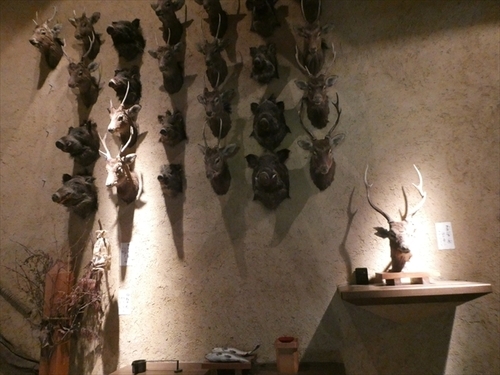
The connection to hunting and, as an extension, war, runs deep in Suwa. Deer are considered a sacred animal in Japan. Most tourists stop at Kasuga Taisha in Nara and are familiar with all the deer wandering around in their grace and beauty. It is illegal to hunt and kill deer in all of Japan, with two exceptions. One of them is the traditional hunting practiced by Ainu in Hokkaidou. The other is certain traditional rites of hunting practiced in the Suwa region! One of the most shocking rituals occurs on April 15. An offering is made of stuffed deer heads stuck on posts around one of the halls of the Lower Shrine and the priests ritually consume venison, along with other game. In the past, the heads were stuck on the posts still raw and bloody with no taxidermy in advance. And there were 75 of them!
TODO: Double-check on the modern status of this ritual. I thought it wasn't practiced any more but a local told me that they still do it, only with taxidermied heads. I'm not sure if there are 75 though!
Even when Buddhism entered Japan and the shrines in Suwa became syncretic, there was a strong aversion to the ideal of vegetarianism. It just never seemed to hold here. There were inventive justifications used: The idea goes that ignorant animals are eaten by humans, then dwell inside of them, and thereby achieve enlightenment along with them. There was a long tradition of special talismans and ritual chopsticks made at Suwa Taisha that allowed people to eat meat without incurring negative karma.
One of the most mysterious and interesting parts of Suwa is the kami (?) known as "Mishaguji." This term itself is very hard to define and is spoken of in quite obscure terms. In short, it seems that they are kami associated with the Suwa area and in particular with the Suwa Taisha. Some have explained them as a kind of retinue of "lesser" kami attending Takeminakata. Again though, it seems as though this is an example of an older, indigenous tradition being appended to something else that had entered the area at a later date.
What can we then say about the Mishaguji? It is a general term for a class of kami found. Some believe that the Lower Shrine of Suwa Taisha was originally dedicated to Mishaguji before Yasakatome. These kami are particularly connected to stones and trees. Suwa has a famed set of seven stones and seven trees which are considered to have special powers connected to the Mishaguji. Representatives of the divine priesthood in the form of young boys visited these stones and trees at the beginning of spring and made offerings to pray for good crops in the middle ages. So some have seen the Mishaguji as "spirits" in stones, trees, leaves, etc. that are related to fertility and abundance.
We also know that the Mishaguji were important "devices" in certain rituals. They were "brought down" during some of the most sacred and severe rituals where priests from the Moriya clan had the sole privilege to summon them into vessels to be inhabited during the ritual and then dismissed. This vessel could be an object or a human. For this reason, Mishaguji were sometimes seen as "curse gods," as those who were to serve as their vessels must be ritually pure or face severe divine punishment. It is said that this punishment would not end at the individual acting as the "vessel," but afflict their family and even their animals as well. Some have even believed that the Mishaguji are described so distinctly that they may be closer to something like the Polynesian concept of Mana or Haudenosaunee (Iroquois) conception of Orenda: a kind of spiritual "stuff" that pervades the entirety of the universe.
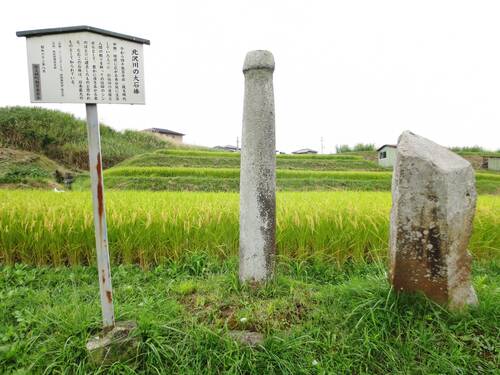
Mishaguji worship seems to be exceptionally ancient, even by the standards of Suwa. There is some similarity to other forms of worship of particularly spiritually resonant stones in eastern/central Japan. This may extend as far back as the Joumon period, as many Mishaguji-associated shrines have prehistoric objects that date to the Joumon era. A common one are phallic stone rods called sekibou. The phallic shape of many of the stones seems to once again hint at their connection to fertility and fecundity. We also know that there used to be a ritual where the chief priest of Suwa Taisha would ritually dwell in a traditional pit dwelling during the winter, which is a Joumon-style dwelling.
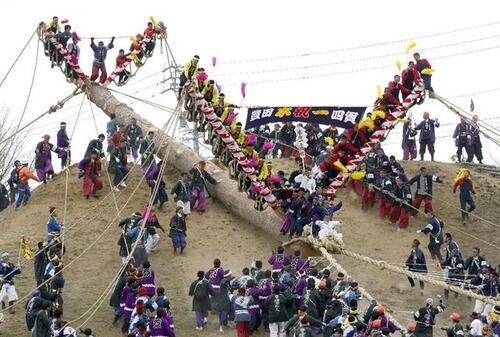
One very distinctive feature is found on every last shrine in Suwa, even the tiniest ones by the side of the road: There are four wooden pillars surrounding them at their four corners. These pillars are called 御柱 (onbashira). The word literally just means "pillar" with an honorific before it. They may have been derived from an earlier sort of tree worship, as we have similar slabs at the edges of many Joumon sites. Of course, they are phallic in shape which may connect them to fertility and to the Mishaguji.
Every six years, during the Year of the Monkey and Year of the Tiger, these pillars are ritually replaced in a spectacular festival called the 御柱祭 (onbashira-sai). The trees are felled in the forest, dragged to the down, and erected entirely by hand, with the entire town doing their part to drag these massive logs to their destination. Every shrine does their own version of the replacing, but the most grand and important are of course the four complexes of Suwa Taisha. The festival dates back to the 8th century and has been considered absolutely essential to observe. Failure to do so would result in horrible divine punishment. People would put off coming-of-age events like genpuku, marriages, and even funerals to assure that they had the money to contribute to the onbashira-sai. We can thank Takeda Shingen for assuring that this event continued even when the Suwa region was torn apart by warfare in the Sengoku period. Women have only been allowed to participate in the event since 1950, but are fully welcome now.
In the first phase of the festival, the trees are selected from a generous selection in the mountains that have been allowed to re-grow and stay sustainable over the six interim years. They are marked with iron sickle blades in advance. They are ritually felled using only axes and adzes (no chainsaws or other power tools). The logs are then decorated in red and white and are dragged down the mountain by hand. They go over some pretty dangerous terrain at times. In a show of daring that resembles something like a rodeo, men will ride these logs as they slide down the mountains and cross cold rivers in acts of extreme bravery. Many have broken bones and even died doing this. But the festival would not be the same without that element of danger. Once they are in the town and merely going down streets, things become easier. But there are huge, V-shaped branches stuck to the side. Originally, these were meant to help the logs pass through muddy terrain. But now they serve as decorative appendages that people ride on as they pass. Finally, they are raised and erected by hand in their shrine. And the bravest ones continue riding them all the way to the top.
Suwa is a magical place and has been considered one for a long time. In fact, there is a traditional claim of there being seven "wonders" or "miracles" related to Suwa, all of which shed some important light on everything we've mentioned so far:
1. 御神渡・Omiwatari
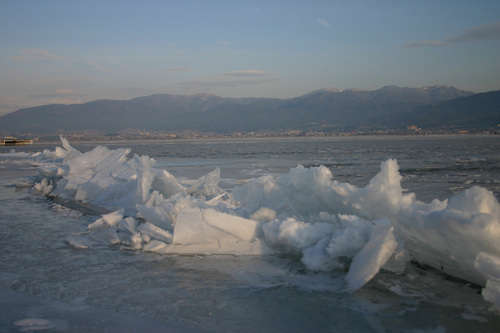
The term "Omiwatari" literally means a "kami's crossing." Lake Suwa is a very unique lake because it has traditionally formed pressure ridges across its surface. What does this mean? In short, think of them as a kind of "mountain ridge" on top of the ice. But how do they form?
Well, the temperature in Lake Suwa is variable due in part to geothermal activity. This means that the surface of the lake can freeze while the water underneath remains warmer. As the surface begins to thaw a bit in the warmth of day, cracks begin to form in the ice and water from underneath flows into them. But when temperatures drop again in the night, the water that has seeped into the cracks freezes as well and starts to expand, pushing the ice around it. When this repeats enough times, the sheets of ice push into each other and make some pretty dynamic patterns across the ice surface. Apparently you can even hear them crunch into each other when you walk out on the surface next to them.
This phenomenon has been known since the Heian period. The traditional explanation is that these ridges are a "kami's crossing." Since the Upper and Lower Shrines are on opposite sides of Lake Suwa, the traditional explanation has been that the ridge is formed by Takeminakata leaving the Upper Shrine to visit his consort Yasakatome on the opposite side of the lake. This has been alternatively interpreted as him walking "across" the lake and leaving an imprint or him swimming under the lake in his serpent/dragon form. (In fact, the traditional explanation of them being caused by a dragon in the lake may have been one reason that this iconography became associated with Suwa Myoujin rather than the other way around.) In any case, the phenomenon has been considered a good omen. Yatsurugi Jinja, the main shrine concerned with this phenomenon, has records that date back to the 15th century charting the size and patterns of the omiwatari over the years and has become an invaluable scientific source for this reason. The size and shape of the omiwatari are also used as a form of divination.
Of course, this story has a very bittersweet conclusion. In the past, omiwatari occurred with such regularity that years without one were considered an extremely bad omen. But with the excess release of greenhouse gases, global temperatures have rapidly risen since the 1980s and shallow lakes like Lake Suwa are especially sensitive to such increases in temperature. Omiwatari have become increasingly rare since the 1980s. The last time that Lake Suwa completely froze and saw an Omiwatari was in 2018 and there has not been one since as of 2025. In 2018, the one that formed was also no more than about 10 cm tall, whereas it was common to see ones which were up to a meter tall in the past. Many locals tell stories of going out on the ice as kids and seeing huge ridges of ice that were as tall as they were. The locals continue to wait for omiwatari each year and see it as an important duty to sit with the lake and have faith. And I hope that someday they will return, as the idea of the shrine's current kannushi being the last one to ever see an omiwatari in person is too much to bear...
Even if the endangerment of the omiwatari was the only effect of global warming, I would still lose none of my zeal for educating about it. We have sullied the most holy place on earth and each of us must now take stock of what we have done. The only thing I know for sure is that the only sight sadder than Lake Suwa with no omiwatari is Lake Suwa with no worshippers at its side waiting for one, so we cannot stop anticipating and praying for it at the right time, no matter what else... I do my best to pray for its appearance every day.
2. 元朝の蛙狩り・New Year's Morning Frog Hunt
A unique ritual occurs at Suwa Taisha every New Year's morning that gives a hint of the ancient, hunter-centric forms of worship that permeate the area. As part of the ritual, a few hibernating frogs are taken out of a nearby river and are shot dead with arrows. The exact symbolism behind the event is debated, but is probably meant to be a re-enactment of Suwa Myoujin's subjugation of the frog kami. The miraculous element of this ritual is that apprently there will always be a few frogs found hibernating in the river for the ritual, no matter what. This apparently even happened in 1707 when heavy rains flooded the area on New Year's and melted all the ice in the water.
As you can imagine, this event draws its share of controversy. It is still performed, but entirely in private away from the eyes of visitors. Every year, tons of PETA activists gather outside the shrine in protest. I will say this: I have visited Suwa Taisha on New Year's and, while I can't exactly say that I agree with the protestors and wish that they were not there, I did appreciate their decorum. None of them were loud or disruptive. They know how to protest while still maintaining a harmonious atmosphere and not standing inside the main hall itself where the ritual actually takes place, allowing visitors to still feel the holy atmosphere. I also will say that I am thankful that the kannushi at the shrine continue to do the rite in spite of protests. I find the protests rather silly. Three frogs being shot with arrows seems like absolutely nothing compared to the amount of frogs that are likely killed with all the other stupid shit we do which SHOULD be what they actually protest.
3. 五穀の筒粥・Tsutsukayu Divination
A divinination ritual involving the brewing of porridge takes place at the Harumiya of the Lower Shrine on January 14th to 15th. Porridge divination is seen in some other parts of Japan as well. In this case, reed tubes are placed in a mixture of water, rice, and adzuki beans and then the tubes are cut open. The amount of porridge that seeps into each one foretells the success of crops associated with each tube. The final tube predicts the state of the world during the coming year.
4. 神野の耳裂け鹿・Deer With a Torn Ear
Above, I mentioned a particular rite where 75 deer heads are mounted on posts as an offering as part of a particulalry lavish hunting ritual. Today they are taxidermied. In the past, they were raw and bloody! It is said that out of those 75, precisely one of them will always have a torn ear.
5. 葛井の清池・Clear Pond of Kuzui
The Kuzui Shrine in Chino-shi (in the Suwa area) has a very scenic little pond to its side. Every year at New Year's, the tools used over the previous year are thrown into the pond as an offering on the evening of December 31st. It is said that every year they miraculously sink to the bottom, disappear, and re-appear the next morning of January 1st in the Sanagi Pond in the neighboring Shizuoka Prefecture.
6. 御作田の早稲・Rice Grains From Fujishima
It is said that when rice is planted on June 30th in the paddies of the Fujishima Shrine in Suwa-shi, they will be able to be harvested as soon as a month later near the end of July. This rice is supposed to be extremely powerful and is used in spiritual rites.
7. 宝殿の天滴・Heavenly Water at the Treasure House
It the Honmiya of the Upper Shrine, there is a small building called the Houden or Treasure House. It is said that every day, no matter what the weather outside is like, three drops of water fall from a hole in the ceiling over the course of the day. It is said that crops watered with this water will not die and that prayers for rain that use this water will always be successful.
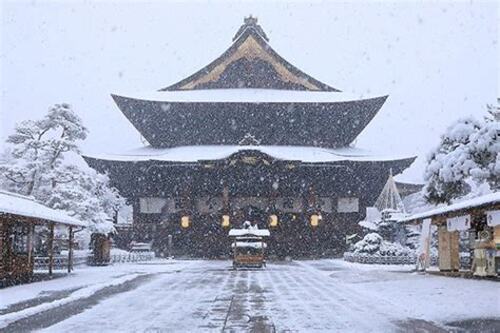
Most of this section has focused on Suwa, which is the most famous spiritual "heart" of Nagano Prefecture. But there are other notable places in the Prefecture. Perhaps the most important place outside of Suwa is 善光寺 (Zenkou-ji), which is a temple that dates from the 7th century in the Prefecture's capital city of Nagano-shi. In fact, it is said that Nagano-shi as a city began as a settlement around Zenkou-ji. The temple is old enough that is predates Buddhism's split into various sects across Japan. To this day it is owned by two separate schools: The Tendai sect in the tradition of Saichou and the Joudo sect in the tradition of Hounen.
Zenkou-ji's claim to fame is that it enshrines a 秘仏 (hibutsu) or "hidden Buddha," a Buddhist statue which is never shown to the public. In fact, the temple maintains that not even the temple priesthood can ever see the statue. No one can see it, period. It is said that this statue is the first Buddhist image to ever be brought to Japan. While the real statue is never shown, every six years a replica of it is put on display for a ceremony called the 御開帳 (gokaichou).
The temple survived and was diligently guarded during the Sengoku era when most of Nagano was a battlefield. It was especially iportant as a strategic base in the wars between Uesugi Kenshin and Takeda Shingen. The temple also protested the 2008 Summer Olympics in solidarity with Tibet (based). Some complete scum of the earth vandalized the temple in retaliation and probably got their social credit score raised while earning a millennium of needles imapling their rectum in the Avici Hell.
「信濃の国」・"Shinano no
Kuni"
Lyrics: 浅井洌 (Asai Retsu)
[TXT FILE]
Composition: 北村季晴 (Kitamura Sueharu)
This is the official anthem of the Prefecture and was created in 1899-1900.
小林一茶・Kobayashi Issa (1763-1828)
Birthplace: 信濃町 (Shinano-machi)
One of the "Great Four" haiku poets along with Matsuo Bashou, Yosa Buson, and
Masaoka Shiki. Used a lot of colloquial language. Wrote a lot of haiku about animals.
His haiku are usually at least slightly humorous. Spent a lot of his life in Edo, but
spent his later early and later life in Nagano. Went through a lot of hardships in
his life, including deaths of loved ones and financial troubles.
松尾多勢子・Matsuo Taseko (1811-1894)
Birthplace: 飯田市 (Iida-shi)
Kokugaku scholar. Peasant woman who had ten children and grew silkworms. Wrote
poetry. In her later life, became a staunch opponent of westernization and supporter
of the Emperor over the shouguns in the lead up to the Meiji Restoration. Seen as a
martyr and hero for nationalists and imperialists.
角田忠行・Tsunoda Tadayuki (1834-1918)
Birthplace: 佐久市 (Saku-shi)
Kannushi and kokugaku scholar who joined the anti-westernization movement and
carried out subversive activities in Kyouto. He entered into hiding during the Boshin
War. After the Meiji government was established, he attempted to enter into politics.
But he was rejected as being too staunchly conservative. Later joined the Atsuta
Shrine in Nagoya and served there until his death. Made it a point to never wear a
single piece of western clothing in his whole life. He only made one exception: He
once wore a suit when he met Emperor Meiji.
永田鉄山・Nagata Tetsuzan (1884-1935)
Birthplace: 諏訪市 (Suwa-shi)
Military officer in the Imperial Japanese Army. Highly supported Ishii Shirou's
studies into biological warfare. Ishii had a bust of Nagata in his office at Unit 731.
Nagata supported reforms that would emphasize the emperor and military over the
bureaucratic state. But he was the leader of the 統制派 (tousei-ha), which urged
gradual and moderate action. This faction was opposed to the 皇道派 (koudou-ha), which
supported a radical and immediate purge of the state and reversion of Japan to a
pre-modernist imperial monarchy. A koudou-ha supporter named 相沢三郎 (Aizawa Saburou)
assassinated Nagata and was executed for it.
清沢洌・Kiyosawa Kiyoshi (1890-1945)
Birthplace: 安曇野市 (Azumino-shi)
Moved to the United States in 1906 and wrote for Japanese-language newspapers on
the west coast. Returned to Japan in 1918 as a journalist where he adopted dovish
positions and urged Japan to relinquish its colonial claims in exchange for peaceful
trade. He held onto these liberal positions into the war period, where he was
critical of the militarization of the culture and government. He wrote diaries during
1942 and 1945 that were critical of the Japanese state and only released in the
post-war period. Died of pneumonia shortly before the end of the war.
草間彌生・Kusama Yayoi (1929-)
Birthplace: 松本市 (Matsumoto-shi)
Very famous Japanese abstract artist. Studied traditional Japanese nihonga but
was influenced by American abstract expressionism. Famous for her installation pieces
involving bright colors and "infinity fields" of polka dots. Lived in New York City
in the 1960s and was involved in the hippie counterculture. Moved back to Japan in
the 1970s and sunk into a deep depression. She has lived in a mental health facility
ever since then and has been upfront about her extreme struggles with unhappiness and
anxiety. She had a fucked up childhood with an abusive mother and unfaithful father,
followed by a constant atmosphere of panic during World War II, so it makes sense.
美川憲一・Mikawa Ken'ichi (1946-)
Birthplace: 諏訪市 (Suwa-shi)
Male enka singer. Not an okama, but very very gay.
Suda51 aka 須田剛一・Suda Gouichi (1968-)
Birthplace: 上田市 (Ueda-shi)
Game designer famous for some unique games under the company Grasshopper
Manufacture. Born in Nagano but moved to Toukyou at the age of 18.
中山美穂・Nakayama Miho (1970-2024)
Birthplace: 佐久市 (Saku-shi)
Idol singer from the 1980s. Actress. Called ミポリン (Miporin) as a nickname.
Famous in some early drama series and later in the film Love Letter by Iwai
Shunji. Died of an accident while bathing in a somewhat unusual case.
ZUN aka 太田順也・Oota Jun'ya (1977-)
Birthplace: 白馬村 (Hakuba-mura)
Doujin game creator who singlehandedly made all the games in the magisterial
Touhou Project series, which are full of interesting attempts to integrate the
mythology and traditions of Japan, including Nagano, into games involving cute lolis
and sick bullet patterns. One of my favorite people, even though his games haven't
been good since 2015. Has mostly kept his personal life private. We know that he is
married, has a son and a daughter, and (most famously) is a beer enthusiast and heavy
drinker.
「御神渡り」の原理を徹底図解!伝説の裏に隠された諏訪湖の奇跡