
The philosophical position known as "antinatalism" is increasingly en vogue in many intellectual circles on the internet. As its name implies, antinatalism is a philosophy that, most simply put, views coming into existence as inherently harmful and thus views procreation as a significant moral wrong. I find this philosophy to be misguided and troubling in its implications. But it does bother me that most of the vocal critics of antinatalism are, to be frank, fundamentalist religious kooks. I view these two as both distorted, extremist views about procreation. The antinatalist wants no one to ever procreate. The fundamentalist wants people to pump out babies in a reckless, thoughtless manner on the basis of nothing but religious dogma. My position is a middle ground: Some procreation is morally justified, some is not, and some is very hard to say one way or another.
This essay will get impassioned at times. I ultimately decided on merely naming it "Why I Am Not an Antinatalist" (in the manner of Bertrand Russell's "Why I Am Not a Christian"). Though I almost titled it "Antinatalism Is a Philosophy for Cucks" and "Antinatalism Is a Death Cult (And Not Even a Cool One)." Why do I feel the need to be so combative? Many antinatalists try to act cute by acting like their philosophy isn't almost necessarily provocative. "Why does everyone get so angry at us? All we're doing is saying that your parents, your parents' parents, your entire evolutionary line, and likely YOU are immoral for having acted upon or wanted to act upon one of the most basic and unviersal human instincts!" The philosophy deserves an intellectually honest critique. But I can't pretend like most of its defenders are aren't incredibly preachy and pushy and weird. And the ideology contributes to low birthrates, which are a seirous problem in many industrialized societities. And no, this is not in contradiction with saying that global overpopulation is also a problem, which it very much is. So I think the gloves deserve to come off a little.
It's also worth not getting several points confused about what antinatalists actually believe and actually advocate for. I can distinguish three "levels" of antinatalism that sometimes get lumped together by opponents of their views. These are what I call "soft" antinatalism, "standard" antinatalism, and "radical" antinatalism or Efilism. I will begin by defining each of these.
"Soft" antinatalism: Most who are sympathetic to these ideas have a pretty "mild" form of it. Their antinatalism is conditional rather than a matter of principles. A lot of them might say that procreation is not inherently a harm, but given the current state of the world it is irresponsible. They argue that it would be best to wait until the world or society one lives in is in a better state before bringing more life into it. The most common framing of this concern is ecological: Earth is overpopulated, so we shouldn't contribute to the problem of overusing the earth's resources until we achieve a more sustainable existence.
"Standard" antinatalism: This is the more philosophically robust form of antinatalism. It is canonically expressed by the most famous antinatalist philosopher, David Benatar. Its position is that coming into being is always a harm for any sentient being. That is, coming into being as always inherently harmful as long as there is even a small amount of suffering in the life created (a single pinprick in a life of bliss, to paraphrase Benatar). Such a position sounds shocking if not outright ludicrous at first, but it primarily hinges on what has been called Benatar's "asymmetry" argument, which I will soon summarize. This view still usually stops short of advocating for suicide, as there is a distinction that sees some lives as worth continuing, but not as worth starting. That said, I personally think this distinction is spurious and it is part of the reason I reject antinatalism.
Efilism: Efilism is an extreme form of antinatalism. The term is rooted in the word "efil" or "life" in reverse, signifying a rejection of the value of life. The term was coined by YouTube vlogger known as Gary Inmendham, who is an unusual character... to put it mildly. This position not only believes that coming into being is always a harm, but that it is morally correct for all current existing life on earth (and in the universe) to be forcefully ended, even against the consent of the living. This ideology believes in deliberately pushing extinction in immediate, radical ways and sees things like mass murder, pollution, and nuclear war as moral goods. This is what, in the very technical, professional jargon, is called a "meme philosophy." Efilism is what "traditional" antinatalists are often stereotyped as believing. But most antinatalists do not believe in anything this unhinged.
With this in mind, I will restrict the criticisms in this essay to the "standard" antinatalist position. If I reject standard antinatalism, then Efilism will necessarily fall along with it. I will return to the concerns of "soft" antinatalists later on, though a full treatment about how to make the world more sustainable is outside the scope of this essay. I simply want to put forward some concerns about the immediate reflex being to abstain from any procreation, which I find to be an incomplete and shortsighted response.
I should also make some things about opposition to antinatalism very clear, because those of us who oppose it are almost by definition "pro-life." But in the United States, the term "pro-life" gets used to refer to those who want to outlaw abortion and are usually theocratic authoritarians of one stripe or another. A lot of the public debates you see with antinatalists are hosted by these cretins, and it is unfortunate that antinatalism almost necessarily looks more appealing by being on the opposite side of religious fundamentalists or weird crypto-Nazis who you can tell use low birthrates as window dressing for a concern about maintaining majority-white demographics. To avoid being thought of as a "pro-life" nut in the POLITICAL sense of the word, I will make the scope of my criticisms be clear:
Opposing antinatalism does not mean that I think everyone needs to procreate. Many adults may choose never to procreate. They may prefer to adopt or to abstain from raising children altogether. I see that as a personal choice and I endorse their right to have the freedom to make it. I simply think that procreation can be and often is a morally permissible and even morally right action. It is very rarely a moral OBLIGATION, but there are some tricky questions of population ethics when it comes to things like declining birthrates that make it hard for me to say it can "never" be one.
Opposing antinatalism does not mean that I oppose interventions that "cancel" births like contraceptives, abortions, and vasectomies/tubal ligations. I believe that access to these should be easily available to those who need or desire them.
Opposing antinatalism does not mean that I am not concerned about the unsustainable living habits of humans and the overpopulation of the earth. It doesn't even mean that I am opposed to forms of population control (a fancy way of saying "limiting the number of children people can have") in the extreme if it comes to it. I again aim to return to this point when discussing population ethics.
Opposing antinatalism does not mean that I am opposed to vegetarianism or veganism. This might seem like a non-sequitir at first. But a lot of antinatalists are vegetarians/vegans and vice-versa. Both tend to operate with a similar understanding of ethics. I am not a vegetarian or vegan, but my full thoughts on vegetarianism and veganism and the ecological concerns related to them deserve another article.
Opposing antinatalism does not mean that I oppose euthanasia or even non-medically-sanctioned suicide under certain contexts. I believe that it can be right for both the suffering individual and the society around them to put an early end to some lives if they are too miserable to continue. This could even be acceptable for some newborns if they have serious enough conditions. However, I believe that easy access to assisted suicide is something that requires a lot of scrupulousness and circumspection. My opinion on it is highly contextual.
Most of this essay will address the arguments of David Benatar, as expressed in his book Better Never to Have Been: The Harm of Coming Into Existence. There are other antinatalists who may differ from Benatar in some details, but Benatar is as good a representative of this position as you could hope to find. Most modern antinatalists somehow overlap with Benatar's positions and love to reference him. In this section I will aim to recreate the argument as honestly as I can.
Benatar begins his argument by assuming that it is the case that there are some lives that are not worth starting. If we were able to do perfect genetic tests and know with 100% certainty that our child would have some horrible disease that would make it live a very short life in almost constant pain, most of us agree that it would be better for that child not to come into existence. This then is supposed to show that it the state of "non-existence" can enter into our judgement as a comparison point to a living child. In this case, we judge non-existence to be a superior alternative to coming into existence. Benatar claims that since we have agreed that it is possible for a life to not be worth starting, we just have to ask how many lives can be judged to be so. His answer is all of them! For Benatar, no lives are worth starting.
You may have noticed that I use the phrase "life worth starting" instead of "life worth living." This is because Benatar believes that the phrase "life worth living" is really ambiguous between a "life worth starting" (is it worth it to create a new being that will have this life?) and a "life worth continuing" (is it worth it for this currently existing life to continue?"). He sees these as fundamentally different questions. The analogy he gives is if we are watching a film or play in a theater and find that it is not as good as we thought it would be. We feel that it would have been better if we did not go to see the film or play in the first place. But it is still "good enough" that we don't feel the need to walk out of the theater and decide that it is better to "stick it out" and see the end. For Benatar, this is what all lives are like. I think this analogy is deeply mistaken and I am very skeptical of this distinction, but I will return to this later.
A memorable aphorism expressing a form of the asymmetry argument (with far more poetic finesse than Benatar's spiritually barren utilitarian number-crunching):
A quick test of the assertion that enjoyment outweighs pain in this world, or that they are at any rate balanced, would be to compare the feelings of an animal engaged in eating another with those of the animal being eaten.
Arthur Schopenhauer, "On the Suffering of the World" [1]
Benatar's extraordinary claim that no lives are worth starting requires extraordinary evidence, and his most compelling argument is that he claims there is an "asymmetry" between an absence of pain and absence of pleasure for someone who does not yet exist. It is easiest to understand if we put it into a schematic table:
 Scenario A (X exists):        Scenario B (X never exists):
┌─────────────────────────────┬────────────────────────────┐
│                             │                            │
│    Presence of pain         │    Absence of pain         │
│                             │                            │
│    (Bad)                    │    (Good)                  │
│                             │                            │
├─────────────────────────────┼────────────────────────────┤
│                             │                            │
│    Presence of pleasure     │    Absence of pleasure     │
│                             │                            │
│    (Good)                   │    (Not bad)               │
│                             │                            │
└─────────────────────────────┴────────────────────────────┘
The idea goes that scenario A contains something bad (the presence of pain) and something good (the presence of pleasure), whereas scenario B contains something good (the absence of pain) and something which is merely neutral and not bad (the absence of pleasure). In terms of a calculation of goodness, then, scenario B wins. Though Benatar is careful not to make this comparison as crude as assigning numerical values to these features, it seems to almost necessarily invite an explanation in numerical terms: The presence of pain is good (+1), the presence of pleasure is bad (-1), the absence of pain is good (+1), and the absence of pleasure is not bad (0). Scenario A would calculate out to a 0, while B would calculate out to a 1. And Scenario B is greater.
Benatar admits that the assignment of an absence of pain being good and an absence of pleasure not being bad is ultimately based on intuition. We could make alternative, "symmetrical" schema. For example, we could say that the absence of pain is good and the absence of pleasure is bad. Or one where we say that the absence of pain is not good and the absence of pleasure is not bad. There's no real proof for Benatar's attribution of the absence of pain as good and absence of pleasure as not bad. But he claims that it has strength because it explains many other asymmetries that most people already find intuitive. I will note the two that I consider to be the strongest and easiest to understand (even if I do not necessarily share them):
1. We think that prospective parents have an OBLIGATION not to bring a child into the world who will suffer unduly, like one who will live in chronic unbearable pain due to some rare disease, for example. On the other hand, we do not consider it an OBLIGATION for prospective parents to bring a child into the world who will be happy (even one who will be EXTREMELY happy).
2. When we look at uninhabited parts of the universe, like Mars, we do not feel that it is bad that there are no happy beings there. But we do feel as though it is a good thing that there are no unhappy beings there.
The other asymmetries will be explored elsewhere in this essay. And these are the two that Benatar always brings up in debates, so they feel like fair representations of his argument at its strongest.
In order to further show that his asymmetry has the best explanatory power, Benatar considers the two alternative "symmetrical" formulations of his schematic which would not entail an antinatalist conclusion, but finds them lacking on the basis that very few of us spend time mourning the pleasures that unborn people lack. He claims that it would be very strange to spend time being sad over people who have never been born being unable to partake in any of the pleasures of life.
Before giving some more evidence at the apparent harm of our coming into being, Benatar entertains a few related asymmetry arguments. He appeals to the argument of Seana Shiffrin, who argues that we should inflict a lesser harm on a person to avoid inflicting a greater harm unless the subject presents an explicit wish not to do so. But we should not inflict a harm merely to produce a benefit, no matter how great that benefit is. For example, it is acceptable to break someone's arm against their wishes in order to prevent them from dying (while yanking them back from to prevent them from falling off a cliff, for example). But imagine if, through some strange contrivance, it were the case that breaking someone's arm would give them the ability to have a perfect photographic memory for learning languages. We would not think it right to break their arm against their wishes just to provide them with that benefit, great though it may be. Benatar says that bringing someone into existence is like the latter case.
This, of course, rests on a presumption that a preference being satisfied and not having a desire at all are equally good. This is a contentious point. To use Christoph Fehige's example: If a tree is red and someone has no feelings about that one way or the other, we don't do them a favor by giving them a pill that somehow makes them desire the tree to be red. So as an application to the antinatalist point, Benatar argues that if someone is never born, they have no desires at all. This is supposed to be equally as good as having all of one's desires satisfied and not experiencing any pain, which is certainly not a state that any of us in existence can claim to have achieved.
Benatar concedes that it could be possible that even if coming into existence always represented some harm, it could still be morally justifiable to procreate if lives were consistently good enough as to balance that harm out. But he claims that most of our lives are actually far, far worse than we realize. Since lives are so consistently terrible, it seems that any life that is superior to non-existence is almost certainly an impossibility on our planet and probably even in our universe. This is another extraordinary claim, so he devotes a whole chapter to evidence for it. It is difficult for me to not find much of this chapter ludicrous on its face, but I will attempt to present it as impartially as I can before I critique it.
Benatar has an immediate challenge in convincing us of his position, which is that most people on earth report to be happy that they exist and to generally enjoy their lives. This is often the case even in cases where it would surprise us. It's not uncommon for even the "worst off," like the chronically ill, to report that they are happy to be alive. Those who are rich or highly educated report slightly higher levels of happiness, but the difference here actually isn't that great. Benatar believes that these people are really deluded about how bad their lives really are.
For reasons that almost certainly have an evolutionary origin, humans are very good at adapting to the bad things in their life and still being happy. We tend to weigh good things more heavily than bad things in our memory and our evaluation of events. There is good empirical evidence of this. A good example may be out experience on a vacation. If we simply looked at how our raw experience during the whole duration of time making up the vacation, a lot of it will be spent in less-than-ideal situations like waiting for luggage on the carousel, waiting in a long line to get into some gallery, eating food which didn't quite live up to our expectations, etc. But we tend to remember the positives of the trip far more strongly and to evaluate the experience on the basis of them. Benatar calls this the "Pollyanna Principle."
Benatar thinks that we have reason to think that the Pollyanna Principle is not to be trusted when it comes to giving an honest evaluation of how "good" our lives are. He gives the analogy of slaves who report to be happy in a life of slavery. Would we trust their evaluation of their lives? No, we would feel that somehow they were deluded and that it would be better if they were free. He believes that we can basically make the analogy of all lives being like slaves. We all would apparently be better off never having come into existence, even if we are deluded and think that our lives are good enough to have been worth starting.
As evidence, Benatar considers three ways to evaluate the quality of a life:
1. A hedonistic perspective (how much of our experience is pleasurable?)
2. A desire-fulfillment perspective (how often do we manage to have our desires
fulfilled?)
3. An objective/material perspective (how much do we adhere to a list of
person-independent points for what a "good life" consists in?).
If we take the hedonistic perspective, Benatar argues that much of our day-to-day, moment-to-moment experience of the world is made up of a lot of negative states of things like tiredness, hunger, itches, aches, sensitivity to heat and cold, and so on. We ingore these in our assessment because we are biased to, but if we were able to see the texture of our moment-to-moment experience over time, we would see that the bad generally outweighs the good. And the goods, for Benatar, are not an improvement over non-existence.
If we take the desire-fulfillment perspective, we also find that more of our desires tend to be unfulfilled than fulfilled. And the experience of fulfilling a desire tends to be very brief and fleeting. We are often a bit more disappointed about how little real change there is in our feelings when we have the desire fulfilled. In contrast, the time we spend not having the desire fulfilled tends to be long and the unfulfilled desire is very conspicuous in our mind during it.
If we take an objective/material perspective, we can assess a life based on the human standard. But this standard is arbitrary. Benatar says that we often bias our assessment of our life by only comparing it to people who are worse-off. But most of us lack many good things that people more fortunate than us have. And even the most well-off of us have very "bad" lives compared to what could be possible. We view a death before the age of 40 as a tragedy, but not a death before 240. But there is no reason not to. And there are usually many more ways we can assess our lives as being worse off than as being better off.
The rest of Benatar's book consists mostly of practical concerns that fall out of the scope of my critique. Most of them are consequences of the asymmetry argument, so any disagreement I have about them would likely just be re-addressing the asymmetry argument.
One chapter is dedicated to a moral justification for aborting fetuses. Remember, for him this will mean not just some example fetus but ALL fetuses. He thinks that everyone should stop having children. And he does mean EVERYONE. He thinks that abortion is justified when it can be judged that being born would be a harm for that fetus. And he says that this applies for ALL fetuses, so it would be morally correct to abort all of them. The question comes up of whether it would ever be right to use legal power to enforce the antinatalist agenda and penalize procreation. This is of course a hyper-theoretical condition as it's almost inconceivable that any policy like this would ever be enacted. But even in this academic context, Benatar believes it would be wrong. This is because there could be potentially reasonable objections to his philosophical position, even if he is currently not convinced by any of them. So on the basis of caution it is better not to be overly ambitious.
He ends the book by considering the question of extinction of the human species. He admits that extinction would be good if it were done by non-violent means (say, humans refusing to procreate and gradually dying off rather than dying by means of a meteor impact, pandemic, climate disaster, etc.). He does not deny that even in this "ideal" state, things will be hard for the final generation (being unable to rely on younger generations for healthcare, for example). But he believes that the canceling of future suffering justifies the suffering of the final generation of humans. [2]
Such is the thrust of David Benatar's book as I understood it. Most antinatalists will somehow or other come back to arguments that are similar to these, so it's become a bible of sorts for the antinatalist movement for good reason. With that in mind, I consider it the best statement of the philosophy to critique. And critique it I now will.
I think the antinatalist argument is greatly mistaken and I reject it for many reasons. Many of these arguments overlap with thinkers besides myself and have in some cases been rephrased from them. I will do my best to credit these thinkers where I can. They include David Wasserman, Todd May, Sam Harris, Morioka Masahiro, and Luke Smith.
It might be confusing what my "position" is along the way in this critique. This is precisely because I think there are good reasons to doubt some of Benatar's conclusions even if you share many of his broader assumptions and frameworks. I happen to disagree with many of these assumptions and frameworks. But I aim to show that even if one did entertain those, there are still reasons to reject the antinatalist argument. I will try to broadly organize these to move from the critiques from the most "similar" backgrounds to those from the most "different" backgrounds. So I might endorse the opinions of some thinkers at some step of the way and not others. This is to be expected. If you can't realize when someone you generally disagree with makes a point you do agree with, you aren't cut out for philosophy. While my own position in this spectrum might not be settled, it's fair to say that me and Benatar are very far from each other in our intuitions on these questions and seemingly even our understanding of what philosophy and ethics are for in the first place.
Many seem to forget that Benatar's argument is ultimately based on intuitions. Just because he sets it up in a schematic table doesn't make it some objective, scientific truth. This is not enough of a reason to reject it. Philosophy itself often consists of the systematization of intuitions. But we have to ask if there is any reason to doubt Benatar's intuitions or the applicability of their scope.
Benatar claims that the asymmetry between the absence of pleasure and absence of pain is ultimately based on intuition and that it is an intuition that most people would share until they realize that it leads to the antinatalist conclusion. That said, I share an intuition with Sam Harris, who fails to understand why Benatar recognizes a spectrum of badness on one side of the ledger but not the other. Even if we believed that ethics could be reduced to Benatar's number-crunching, it would make more sense to see "non-existence" as a zero point or neutral baseline. As there is no subject there, there is no one to mourn the lack of pleasure, but no one to be relieved of the burden of pain either. And we would see degrees of pain and pleasure as moving away in opposite directions. [3] But Benatar only recognizes this for pain:
 Harris's view:                      Benatar's view:
┌─────────────────────────────────┐ ┌─────────────────────────────────┐
│                       ▲         │ │                                 │
│                       │         │ │                                 │
│                       │ pleasure│ │                                 │
│                       │         │ │                                 │
│                       │         │ │                                 │
│─────┬─(non-existence)─┴─────────│ │─────┬─(non-existence) = pleasure│
│     │                           │ │     │                           │
│pain │                           │ │pain │                           │
│     │                           │ │     │                           │
│     │                           │ │     │                           │
│     ▼                           │ │     ▼                           │
└─────────────────────────────────┘ └─────────────────────────────────┘
Why does Benatar assume that pain is much worse than non-existence but not that pleasure is much better than non-existence? Why does he endorse a spectrum of value between the one pair (pain and non-existence) but not the other (pleasure and non-existence)? Why does he believe that the lack of pain is a good thing when there is no subject there to enjoy that relief (but not that the lack of pleasure is a bad thing when there is no subject there to suffer that absence)? I see no reason to reject Harris's view as an alternative, and indeed it seems much more "common-sense" to me.
Benatar would probably allude to the two "asymmetries" that we experience which seem intuitively true:
Intuition A. We feel that prospective parents have an obligation not to bring suffering children into the world, but not that they have an obligation to bring happy children into the world.
Intuition B: We do not feel bad about uninhabited parts of the universe that are devoid of pleasure, but we feel good that they are devoid of pain.
Intuition A seems like a view that starts to fall apart when it moves beyond a very limited, individual scope. It may be true that we do not consider most people to have a duty to bring happy children into existence. But I think part of the reason for that is that we unconsciously assume that there will be many other happy children brought into existence even if this particular set of prospective parents do not. If no one else in the world brought happy children into existence, I feel as though our intuitions would quickly begin to change. For an allegory: We might not feel as though any individual person has a moral obligation to become a doctor. But if NO ONE else on earth was willing to become a doctor, it would suddenly seem very important for there to be more doctors!
Benatar might give the example of a child with a severe condition who would have a life of excruciating pain. If prospective parents knew that this would be their child's condition, they would refuse to bring that child into existence. I think most would agree with this. But it seems extremely odd to grant this an equal status as the child having a perfect life with no pain. For while preventing the first child from coming into existence may be the best choice, very few parents would do so with any joy. They may sink into a deep depression because of it. And not just for selfish reasons of themselves not getting to enjoy having a child (more on this cynical assumption later). That is because they realize that they may be cancelling even a very small amount of pleasure that said child could experience. And if we feel sad even with this, how much more reason would there to feel sad about cancelling the future pleasures of a child who would have a "normal" life?
Intuition B also seems to take "existence" for granted and would not be preserved without it. In fact, I doubt the universality of this intuition even on its face. I think many people do feel some degree of sadness about the emptiness of the universe. What is it that animates our desire to make science fiction stories about aliens and space colonization? I think we have a natural desire to want to see life in the cosmos. It's possible to be opposed to space colonization to preserve the "peaceful" and "undisturbed" nature of planets like Mars. I share this position. And part of that is, indeed, a feeling that it is good that there is no suffering there. It is a nice feeling that there is no war and slavery and murder on the surface of Mars (yet). But the relief of this is based on how it makes ME feel. When people rejoice over this, I think they are in a sense subconsciously imagining what it would be like if THEY were on Mars, enjoying that lack of suffering. I think we enjoy that there are parts of the universe devoid of suffering precisely for the PSYCHOLOGICAL effect it has to know that there is still so much that is unspoiled by us.
I do not want to imply that because they center on how it makes us as existing creatures FEEL that these concerns are somehow less worthy or real. I think they are deeply important ones. But the point is that they are justified on the basis of there conscious beings ALREADY EXISTING on Earth. If there were no conscious life left on Earth, the absence of pleasure on Mars would be much harder to deal with. Even as I say this though, I can only imagine entertaining this thought if I was somehow the last surviving human observing this situation from a space shuttle orbiting the planets. Because that is the only basis I can use to even evaluate these things. Existing is simply a prerequisite to even entertain these questions of value. If there were no more conscious beings, there would be no suffering but also no one there to be relieved of it. So I see no reason to rejoice over the lack of pain but not to mourn over the lack of pleasure.
Benatar claims that the phrase "a life worth living" is ambiguous between "a life worth starting" and "a life worth continuing." He claims that no life is worth starting (coming into existence), but many of our lives are worth continuing (remaining in existence, i.e. not killing ourselves). This whole distinction is what keeps antinatalism from lapsing into Efilism and becoming a "pro-mortalist" philosophy. It's why David Benatar himself has refused suicide and chosen to remain in this existence that he goes to such lengths to argue is so horrible (like a true bodhisattva, what a saint... *eyeroll*). However, I agree with Sam Harris's point that this distinction seems like having one's cake and eating it too, in a sense. If I wanted to be uncharitable, I would discount it as a kind of psychological defense mechanism Benatar uses to avoid committing suicide that is clumsily tacked onto his argument to make him not appear hypocritical. I will follow much of Harris's argument in this section.
Benatar views the moral weight of the presence or absence of pleasure as massively changing once someone comes into existence. That is, there can be no harm in depriving a non-existing person of some future pleasure. But there IS very much a harm in depriving an existing person of some future pleasure. By the same token, he sees eternal non-existence as a preferable state to continuing life for someone who does not yet exist. But he sees dying as a genuine bad for people who already exist (minus excruciating circumstances as might warrant something like euthanasia). That is because he claims that while no one who does not yet exist have an interest in coming into existence, those who already do exist do have an interest in continuing to exist.
Harris poses a question to Benatar: Would it be a bad thing for every single sentient being on Earth to painlessly die in their sleep? This thought experiment removes most of the things we generally associate with death that are unpleasant. There would be no pain. There would be no agonizing anticipation of death on behalf of the one who dies. There would be no sadness or bereavement for those who survive the dead, as there would be no one around to bereave. There wouldn't even be animals who suffer from humanity's extinction due to unsupervised nuclear reactor meltdowns or the like, as all the other sentient beings would go extinct alongside us. Benatar says that this is a bad outcome. But it seems very hard for him to give a reason besides life, somehow, in some situations, being preferable to non-existence. And it's hard to tell why this should not also apply for those who do not yet exist and could come into existence to enjoy such a life and share such interests in continued existence.
Benatar believes that the goals of merely potential people do not deserve moral weight, as there is no harm if these people never come into existence. But it's hard to give a reason why not to discount OUR future goals for the same reason. The identity between our present selves and our future selves is, in a sense, conventional. Our future selves are equally potential. For that reason, it is extremely hard to understand why death (removed of all confounding variables like the pain of death, anticipation of death, and effect our death has on those who remain) is not preferable to continued existence if life is truly so horrible as to make non-existence preferable in all cases. As Harris puts it, whatever ledger exists to record the "bad" that happens with the cancelling of our future interests must exist in the same "nowhere" as the absence of benefits of life to someone who does not yet exist. [4]
There is one alternative I have not considered: What if Harris and I are actually correct and there is no distinction between an antinatalist and a pro-mortalist position, but that simply means that the pro-mortalist position is ultimately the correct one and that it truly would be a good thing if all sentient beings died painlessly in their sleep? Well, one simple reason I can give is that I do not want to die, even if I didn't experience any of the "evils" related to it! We can only do ethics from that perspective. Imagine that someone broke into my house, secretly recorded me taking a shower, and shared it with thousands of people. Now imagine that I never found out about this. Would I have been wronged? I believe so. We can still say that there would be harm if everyone on Earth died even if no one was around to "experience" that harm. It also becomes very hard to argue against the "goodness" of things like mass-murder and genocide if we accept this position, because most antinatalists already accept the idea that we should commit a lesser evil on someone in order to protect them from a greater one (remember the "breaking an arm to save someone's life" example).
Of course, we also might want to reject the pro-mortalist position just because David Benatar is still alive. It's normally not the best practice to deny the soundness of a moral philosophy just because the philosopher putting it forward doesn't embody every aspect of it. No one is a moral saint. Being able to argue that something is morally correct doesn't mean one is forced to follow it in all cases, even if one recognizes that it would be morally correct to do so. But Benatar's argument pays special attention to intuitions. His argument for asymmetry relies on us "just feeling" that it is right. But most of us "just feel" that it is right to continue existing, even when Benatar's supposed arguments for the value of our continued existence seem so flimsy and insubstantial compared to non-existence by his account.
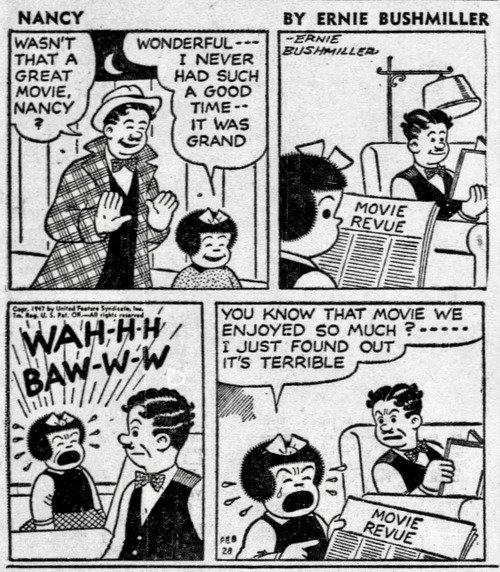
Pictured: An antinatalist reading David Benatar's book for the first time.
Benatar goes so far as to admit that even if coming into existence is always a harm, it might be a justifiable harm if life was consistently good enough to make up for whatever that harm might be. But he claims that we are actually quite deluded about how good most of our lives really are. He claims that even if we limit our sample to the minority of living beings on Earth who are lucky enough to live in abundant, industrialized societies, life usually contains far more pain than pleasure. He claims that the "Pollyanna Principle" is just an evolutionary adaptation which makes us blinded as to how bad things really are.
The title of this section, however, is instructive. I think most of the disagreements Benatar would have with those of us who are Pollyannas are as insubstantial as disagreeing that a glass is half empty instead of half full. It is not to say that evolution has not distorted our understanding of what is really the case in many cases. An optical illusion that two lines are different sizes when they are genuinely the same size is the kind of thing that can be reliably proven to be a delusion. But there is no scientific assessment of whether a life is "good" or "bad." What Benatar chooses to give weight to in evaluating a life seems to me to be very subjective, despite being cloaked in language that gives them the appearance of being dispassionate assessments of the facts.
To recall, Benatar examines three potential perspectives for what makes a life
good. These are:
1. A hedonistic perspective (how much of our experience is pleasurable?)
2. A desire-fulfillment perspective (how often do we manage to have our desires
fulfilled?)
3. An objective/material perspective (how much do we adhere to a list of
person-independent points for what a "good life" consists in?).
In my opinion, all three of these are simplistic criteria for what makes a life good. There are some more detailed critiques about them that I will address later when I criticize the foundations of a utilitarian framework for answering ethical questions. However, I can offer some criticisms of his analyses of these seem unconvincing even with his assumptions.
One reason, formulated by Todd May, is that it's not at all clear why we should so readily assume that the "Pollyanna Principle" is really a delusion or misreading of the way things are. What if the goods in life really DO outweigh the bads, even if the bads are more omnipresent (as Benatar makes a decent case for)? Nor does this even have to entertain the idea that bad things are necessary as a point of comparison for good things to be good. The goods just might REALLY be that good. [5] How can we be so sure that this isn't the case?
David Wasserman notes that Benatar is guilty of applying his standards inconsistently here. He is happy to take people's word as authoritative when they report the suffering of things like hunger, illness, misery, and the like. But when they report finding their lives overall to be worth starting, he finds reasons to call them deluded and biased and to discount their input. I see no real justification for one over the other. He gives the example of happy slaves, but just because some people might be deluded about the true goodness of their lives, why should it follow that we ALL are? [6] Benatar also concludes that we are deluded into thinking our lives are better than they truly are because we tend only to compare them with people who are worse off, instead of those who are better off, even including theoretical super-civilizations who could theoretically be many orders of magnitude better off than us. However, the latter of these (those who are better off) is just as arbitrary as the first (those who are worse off). If somehow the "arbitrariness" of it as a starting point is supposed to make it a delusion (which is itself a dubious claim), it's hard to see how the other is any less deluded. [7]
It's true that none of this might make it an OBLIGATION to bring happy children into existence in the same way it would be to keep an unhappy child from being brought into existence. But does it at least give us a JUSTIFICATION to do so? I think so. But so far I have been doing my best to adhere to as many of Benatar's assumptions as possible about what truly values in life. Now I wish to take a step back and make some more fundamental critiques about what his philosophy implies really matters most. I believe that his thought is incredibly shallow in this domain.
My critiques so far have more or less stuck to the framework that contemporary antinatalist thought tends to operate in, which is known as negative utilitarianism. Utilitarianism in ethics tends to adhere to the belief that the greatest actions are those which maximize what is good for the greatest number of conscious beings. Negative utilitarian ethics simply reverses the emphasis: Rather than maximizing what is good for the greatest number of conscious beings, the greatest actions are those which minimize harm for the greatest number of conscious beings. While this more or less grasps the idea of what an ethical system should try to do, there is something very sterile and inhuman about it which doesn't capture the full range of ethics.
In this section, I still intend not to fully reject the framework of utilitarianism outright, but to critique antinatalism's particular spin on it. I particularly question the priority it gives to risk aversion, pleasure, and the individual as the locus of morality.
Kids, you tried your best and you failed miserably. The lesson is: Never try.
Homer Simpson, apparently a negative utilitarian [8]
Even if antinatalists don't go to the extreme of arguing that ALL lives are necessarily inferior to non-existence by virtue of non-existence and a perfect existence being equal, many argue that the degree of possible suffering we expose a new being to is so great that it is a severe act of negligence. There is always a chance that the child we give birth to will have a life that is not worth living. And in antinatalist Matti Häyry's words, this "gambling with other people's lives" is immoral. This phrase is evocative, but beneath the rhetoric it's a rather flimsy critique. [9]
David Wasserman points out that this view fails to make a distinction between committing a harm against someone and merely exposing them to harm. This distinction seems to matter very much. The real immorality of it seems to happen when we impose UNNECCESSARY risks. He gives the example of someone driving sober versus driving drunk. Both necessarily expose others to risk. But the former is a reasonable and necessary risk, while the latter is not. It may be possible to reduce some of these risks, but these seem better instituted at the level of public policy rather than individual actions.
Antinatalists might think that "exposing" beings to harm is enough to make procreation immoral. But this is questionable. We always take these risks, because we always "gamble" with others' wellbeing. Indeed, with their lives. But this is completely normal and non-controversial in our daily lives. We send our children to school even when we know that we expose them to potential harms by doing so (bullying or social stigma, poor pedagogy, friendships that may go sour, etc.). But we understand that the alternative of depriving them of education is a greater evil. Even if school was considered too great a harm, the same "gamble" would emerge if we homeschooled our children. We cannot escape this. [10]
It might be logically true that non-existence is the only perfectly risk-free option. But there are no benefits here either. It is uncertain why procreation should have a zero-tolerance policy for risk when very few other ethical decisions we make are so black-and-white. What would we do if we heard someone say that they will never leave their house so that they will never get run over by a car? We would probably find them to sound extremely unhinged and feel that they are being deprived of all sorts of goods in life, even if we can understand that he is logically correct. It is very hard for me to understand how the antinatalist position is different from this.
Antinatalists may respond that the difference is that this shut-in is already in existence and thus being deprived of some good, whereas the non-existent being is not. But I've already explained that I think they apply this standard inconsistently: If there is no "bad" in the non-existent person missing out on what is good, I don't see how there can be any "good" in the non-existent person being spared of what is bad. And if it's merely a "neutral" state like this, I don't see why it isn't a net advantage to bring them into existence if we've concluded that the potential for good in their life will outweigh the risk of bad.
The antinatalist argument largely rests on the priority that pleasure, satisfaction, and happiness have to a life worth living. Whenever critics doubt that these should have fundamental priority to establishing the worthiness of a life, antinatalists quickly accuse them of callousness. "You only say that because you live a privileged existence and don't have to experience the kind of suffering tons of people do on a daily basis!" That said, this appeal is strange considering the vast majority of antinatalists are very well-off, educated figures in wealthy, industrialized societies. This is admittedly a bit of a cheap shot. I almost never believe in "gatekeeping" philosophical truths. But we should find that a bit suspect if those with the greater access to pain are supposed to therefore have greater authority, which is what that antinatalist response does.
Antinatalists also play a strange game when they use words like "suffering" or "pain." They claim that lives in wealthy, developed societies are not worth starting because of "suffering" and "pain" and often give examples that extend to things like not getting the character you want in a gacha pull. But when you critique this as sounding absurdly over-sensitive, they will point to things like famines and genocides as examples of "suffering" and "pain." I frankly have doubts whether these things can even be considered as part of the same category considering how far apart they are from each other in their experiential character. However, even if we do accept that these are both on the scale of "suffering," it still seems extremely clumsy and disingenous to talk about them in the same broad language.
We should be wary of those who over-romanticize pain and suffering when they have not experienced its depths. But suppose we take seriously the concern that there is a great deal of suffering inherent in existence, that much of this suffering truly has no silver lining, and that there can be lives with so much suffering that it means that they are not worth having started (perhaps far more than we realize, in fact). Even if we grant these positions, it does not follow that the amount of suffering in a life should be the primary determinant of its quality and worthiness.
Work, worry, toil and trouble are indeed the lot of almost all men their whole life long. And yet if every desire were satisfied as soon as it arose how would men occupy their lives, how would they pass the time? Imagine this race transported to a Utopia where everything grows of its own accord and turkeys fly around ready-roasted, where lovers find one another without any delay and keep one another without any difficulty: in such a place some men would die of boredom or hang themselves, some would fight and kill one another, and thus they would create for themselves more suffering than nature inflicts on them as it is. Thus for a race as this no stage, no form of existence is suitable other than the one it already possesses.
Arthur Schopenhauer, "On the Suffering of the World" [11]
It is ironic that the above paragraph comes from an essay which is generally considered one of the oldest pure "antinatalist" texts, as I think Schopenhauer is precisely correct here but that it can actually argue the opposite case: States of pain, frustration, dissatisfaction, etc. are deeply entwined with our conception of what is good in life. In a way, pain can be a blessing. If we never experienced pain, we would burn our hands on hot stoves. A good video game is one that challenges and indeed "frustrates" you a bit. Pain and pleasure seem to me to be tools we have evolved in order to further the process of evolution, and it seems like going through the process of overcoming pain to attain pleasure is something we are destined to want to do. People wouldn't do crazy shit like try to beat really hard games without ever taking a hit if it wasn't hard-wired into us. Benatar might see that as a curse. I see it as a blessing that we are able to have such an ability to respond to pain, and it's not really clear why his view should strike us as somehow more objectively true. I return to the question of the codependency of pain and pleasure in section 6.
It is also worth wondering if there can't be states that are higher than pleasure when it comes to a life being "fulfilling." John Stuart Mill recognized this early on. He argued that there were higher and lower levels of pleasure. Some would say that he was guilty of a form of "speciesism," because he made the claim that humans were capable of the higher level but animals were only capable of the lower. "Better an unhappy Socrates than a happy pig" was his dictum. We might see this as an unjustly anthropocentric view which is callous towards real animal suffering in the world around us. But it does strike me as worth entertaining the idea if things like virtue (loyalty, bravery, compassion, creativity, etc.) can be valued above pure "pleasure" or at least as higher levels of it that truly change the calculus at the base. I return to the discussion of virtues in section 3.c.i.
I see antinatalism as a philosophy that really is the worst of both worlds: It has all the downsides of a radical individualism but none of its upsides. It locates all moral good at the level of the individual and thus is shortsighted of the scope and breadth of human meaning, but at the same time it treats individual experiences as largely interchangeable and thus denies individuals their uniqueness and personal dignity.
When I fault antinatalism for being too "individualistic," I do not mean to fault it for being too "self-centered." Many antinatalists are accused of mistaking their own anhedonic experience of the world for being some kind of objective truth about the real nature of existence. The common response is to say that antinatalists need not come to their conclusion by merely observing their own suffering, but may very well do so by looking out into the world and being rightly moved by the very real suffering that exists all around us. So to accuse the antinatalist of being "individualistic" is not to accuse him of prioritizing his concerns or interests over those of another being.
When I accuse antinatalists of being "individualistic," I accuse them of assessing all moral questions from the perspective of an individual. When you look at Benatar's asymmetry table, it is based around whether ONE individual being coming into existence will suffer or not. And he concludes that this individual being always has no interest in coming into existence. What he does not assess is the worth and value of cultures, civilizations, ecosystems, and higher-level existences. He does not attach value to the networks of life that exist at a level higher than individual humans.
Some of this perspective is rooted in my animist views, which I aim to spell out more carefully in later essays. Much of it is inspired by Alfred North Whitehead's process philosophy. The simplest way I would explain it is that I view individuals as organisms, but I also view cultures, civilizations, planets, and the like as organisms in their own right. We, as humans, are essentially colonies of cells, bacteria, viruses, etc. that have evolved a remarkable ability for consciousness and, as Benatar rightly recognizes, an interest in continued existence. I view his view as essentially supporting a kind of murder, but a murder to a higher-level organism that is composed of our living selves among potentially infinite other things. I return to this from the perspective of consciousness in 3.c.ii.
From a more "grounded" perspective, we can ground this in some more common intuitions. Benatar says that we do not spend time mourning the lack of happy people on Mars. But I would say that this is only because THERE IS LIFE HERE. It is very hard to entertain this from the "non-existent" perspective, because as humans we just cannot get outside of our own existence. But I would think that if, as far as we know, the only light of consciousness in the universe was snuffed out, that would be very sad indeed.
Todd May notes that this touches on a question in environmental ethics about the value of species. One perspective says that it is okay to hunt deer as long as the species of deer remains. Their existence as the unique species that they are is what has value (independent of any instrumental benefit they may have as food, or aesthetic objects, or preservers to an ecosystem). Another would say that it is not okay to hunt deer, regardless of what became of deer as a species. The interests of individual deer is what has value, regardless of whether their species continues or not. This question doesn't necessarily change even when we accept that the whole distinction between "species" is largely conventional and subject to revision. We can say the same about many things we care to preserve.
In any case, the antinatalist view is clearly the latter: There is no special value in "species." Antinatalists would cheer on the extinction of deer if they could hypothetically be erased from existence painlessly. Of course, in reality almost no species could be erased from existence without causing pain to other species (depriving them of food, aesthetic appreciation, ecological preservation, and the like), which would give most antinatalists pause. But as a theoretical idea, it would be ideal for them. Benatar himself is not afraid to scale this up to humans. He claims that we are sentimental towards our species as a species and that it biases us away from reducing individual suffering. But I don't know what the alternative would be. All animals are "sentimental" towards their own species, it seems, as most of them are extremely industrious towards reproduction at all costs. Far more than humans, in fact. And to me that only speaks towards something higher that is valuable: The continued existence of higher-level organisms (species as a collective).
An antinatalist critique of this idea accuses us of "using" others as means to an end in this example. Is it worth "sacrificing" the well-being of humans in the meantime in order to get to some theoretical future utopia? But I find this critique on "using" people and treating them as "means" instead of "ends" to itself be a misguided remnant of Abrahamic thought. The truth is that we treat others as means all the time. We can't help BUT to do so. The world first appears to us as equipment that I use, and it is by testing the applicability and utility of what is around me that I come to know what things are. We understand the world in terms of possibilities, which is another way of saying "uses." Children use their mothers for nurturing and sustenance. We use the air and sunshine for oxygen and vitamin D. The only way this thought becomes sinister is when we somehow assume that seeing something for its "use" somehow leads to the next step of "You can do whatever you want to them and no longer see them as something with its own dignity." I think the entire means/ends distinction is suspect and is a remnant of Abrahamic fear of objects. We might "use" future generations, but this is just a cynical way of viewing something which is very natural and can look quite compassionate and loving in a different context.
Anyway, the tradition of Utilitarianism was always a failure, but it's an interesting sign of the times. The Enlightenment was a time of some (less than usually thought) scientific advancement and the idea was that as we began to understand the nature of the body and the stars and everything else, we could fully understand too human society.
Eventually we could engineer and control them all. But as fast as we learn things about the world, even faster do complications arise and we end up "[restoring nature's] ultimate secrets to that obscurity, in which they ever did and ever will remain" in Hume's words.
The only really unfortunate thing is that the ruling class of the West either doesn't know or does care. There's a cynical sense in which they are attempting to re-engineer or "Build Back Better®️" the world on Utilitarian principles where every decision is determined to be acceptable by some centralized utilitarian calculus.
Luke Smith, "The Problems With Utilitarianism" [12]
Utilitarian: one who believes that the morally right action is the one with the best consequences, so far as the distribution of happiness is concerned; a creature generally believed to be endowed with the propensity to ignore their own drowning children in order to push buttons which will cause mild sexual gratification in a warehouse full of rabbits.
To a connoisseur of normative moral theories, nothing says "outmoded and ridiculous" quite like utilitarianism. This view is so widely reviled because it has something for everyone to hate. If you love honesty, you can hate utilitarianism for telling you to lie. If you think that life is sacred, you can hate utilitarianism for telling you to kill the dying, the sick, the unborn, and even the newborn, and on top of that you can hate it for telling you in the same breath that you may not be allowed to eat meat. If you think it reasonable to provide a nice life for yourself and your family, you can hate utilitarianism for telling you to give up nearly everything you've got to provide for total strangers, including your own life, should a peculiar monster with a taste for human flesh have a sufficiently strong desire to eat you. If you hate doing awful things to people, you can hate utilitarianism for telling you to kidnap people and steal their organs. If you see the attainment of a high quality of life for all of humanity as a reasonable goal, you can hate utilitarianism for suggesting that a world full of people whose lives are barely worth living may be an even better goal. If you love equality, you can hate utilitarianism for making the downtrodden worse off in order to make the well even better off. If it's important to you that your experiences be genuine, you can hate utilitarianism for telling you that no matter how good your life is, you would be better off with your brain hooked up to a machine that gives you unnaturally pleasant artificial experiences. No matter what you value most, your values will eventually conflict with the utilitarian's principle of greatest good and, if he has his way, be crushed by it. Utilitarianism is a philosophy that only... well, only a utilitarian could love.
Joshua Greene, "The Terrible, Horrible, No Good, Very Bad Truth About Morality and What to Do About It" [13]
The threat to man does not come in the first instance from the potentially lethal machines and apparatus of technology. The actual threat has already affected man in his essence. The rule of enframing threatens man with the possibility that it could be denied to him to enter into a more original revealing and hence to experience the call of a more primal truth.
Martin Heidegger, "The Question Concerning Technology" [14]
"Enframing" or "Gestell" in the original German is a term introduced by Martin Heidegger in some essays that are as prescient and true as they are obscure and difficult to understand. I have an in-depth lecture about later Heidegger that sets these critiques in a greater context for those who want to understand this concept in more depth. But the essential claim is this: Because of modern technology and, more broadly, the post-Enlightenment worldview that sustains it, humanity has become increasingly unable to allow things to present themselves to us as anything but "standing-reserve." We have become extremely good at measuring and calculating. Because of this, we have fallen under the illusion that all meaning is really a form of measurement and calculation. But this is not true. It is just that we are so locked into one form of "revealing" that everything suddenly takes the shape of "standing-reserve" or material to be manipulated, engineered, controlled, and the like. Utilitarianism is the apex of an ethical system built on such faulty grounds. It seems to me to be a very limited view of ethics which is built on shaky grounds from the outset.
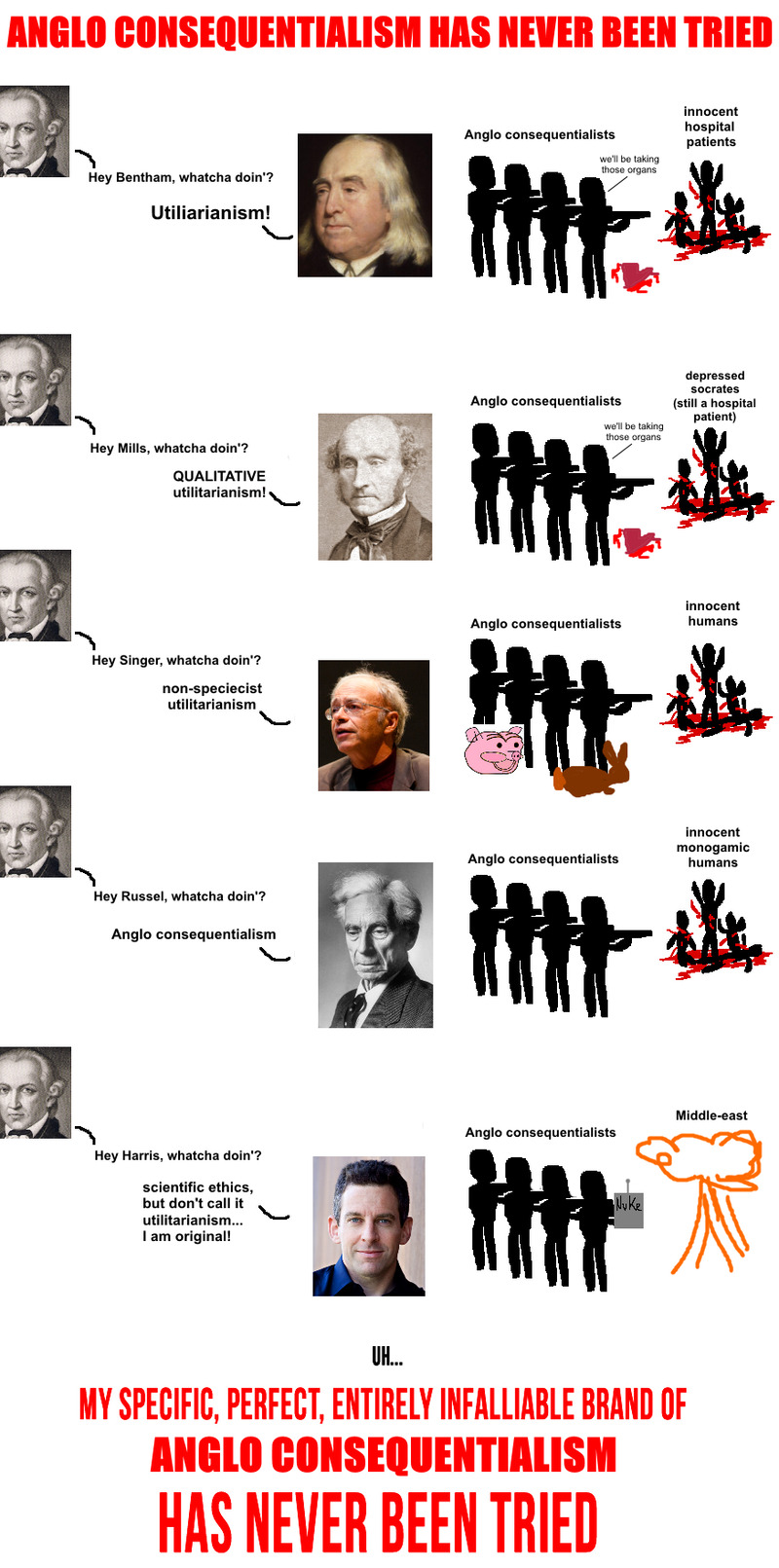
The name of this section is taken from Luke Smith, who wrote what I see as fairly solid and very succinct critique of the utilitarian framework. He summarizes his position as such:
We cannot quantify any particular feeling.
On top of that, we cannot compare the values of different feelings.
On top of that, we certainly cannot weigh the subjective feelings of all humans or beasts against other humans' feelings.
On top of that, even if we could do that, we can't maximize for utility in such a way to maximize all individual happiness and collective happiness simultaneously.
Utilitarianism isn't just impossible, it's impossible every step of the way.
To be clear, these are not technological problems that a future totalitarian government might be able to "solve." There really is no coherent sense in which we can put a number to a certain feeling of happiness and subtract from that another person's feeling of unhappiness. Qualia are qualia. It's like subtracting the sound of an airplane from the color blue.
Luke Smith, "The Problems With Utilitarianism" [15]
Pleasure and pain, goodness and badness, virtue and vice, and the like are not capable of being measured with mathematical formulae. There are no "units" of happiness or sadness. To paraphrase Luke Smith, imagine how you felt the last time you got a present you really enjoyed. Now try to imagine yourself exactly TWICE as happy, or 100 TIMES as happy. You can't do it. And even if you could, you have no idea how it could be weighed against another person's happiness. There might be some "tells," like the activity of neurons. But twice as much neural activity does not translate to twice as much happiness. Any numbers or priorities we give these are arbitrary. David Benatar weighs non-existence to be preferable to existence because of something more or less like this:
 Scenario A (X exists):        Scenario B (X never exists):
┌─────────────────────────────┬────────────────────────────┐
│                             │                            │
│    Presence of pain         │    Absence of pain         │
│                             │                            │
│    (Bad, -1)                │    (Good, +1)              │
│                             │                            │
├─────────────────────────────┼────────────────────────────┤
│                             │                            │
│    Presence of pleasure     │    Absence of pleasure     │
│                             │                            │
│    (Good, +1)               │    (Not bad, 0)            │
│                             │                            │
└─────────────────────────────┴────────────────────────────┘
But what if I assigned these numbers instead?
 Scenario A (X exists):        Scenario B (X never exists):
┌─────────────────────────────┬────────────────────────────┐
│                             │                            │
│    Presence of pain         │    Absence of pain         │
│                             │                            │
│    (Bad, -5)                │    (Good, +10)             │
│                             │                            │
├─────────────────────────────┼────────────────────────────┤
│                             │                            │
│    Presence of pleasure     │    Absence of pleasure     │
│                             │                            │
│    (Good, +50)              │    (Not bad, 0)            │
│                             │                            │
└─────────────────────────────┴────────────────────────────┘
What makes this wrong? Nothing. Because pleasures and pains have no numerical value and any we assign on them is arbitrary. And I am not even inclined trust the idea that we can indeed compare all pleasures or pains. Benatar flattens out all goods and bads in the most insensible fashion. He is totally disconnected from the texture of experience. He never has any scale of something like "meaningfulness" in life. As Todd May says, he has no way to account for a life that is curious, or spontaneous, or adventurous, or loyal, or deeply thematic in any other way. These are not meanings that can be narrowed to the felt degree of goodness or badness of some particular moment, nor to the aggregate of them. Lives can have strong narrative meanings that transcend a crude calculus like Benatar's. [16]
I do not claim that utilitarian frameworks can have no use in ethics. For practical questions of things like distributing resources or influencing policy, they can potentially be the lesser of two evils. It's why I support the autistic number-crunching of the Founders Pledge Climate Fund in addition to the spiritual granduer of the Global Center for Indigenous Leadership and Lifeways. But it seems unbelievably inhuman and just wrong to subject all of this to a system of calculations. But it, sadly, makes perfect sense to be the most popular ethical system for a generation of zoomers raised by social media platforms and trained to view all approval, enjoyment, love, support, and friendship in statistics like Likes, Retweets, Favorites, Followers, and Donations.
The antinatalist weighs our lives as a schematic table. For the antinatalist, life is a ledger where the answer of whether life is worth living is a matter of calculation. But we just do not experience our lives as a ledger. And we really have to wonder why someone would want to assess life in a way which is so unbelievably disconnected from our actual experience of the world. The ultimate cash value of the worthiness and goodness of our lives is always experience. It confuses me why on earth anyone would try to ground it in anything else.
And when we have an honest understanding of what existence actually entails, the antinatalist perspective looks even more suspect. Benatar weighs up our pleasures and pains in order to say whether a life is worth living. But plesaures and pains are transient. Why should a past or future pain discount a present pleasure? Why do they need to be entered in a ledger and weighed up? In truth, there is never more than a conventional reason to even view ourselves as the same human with continuity through our life. Whatever importance past suffering can have to us in the present is an evolving, multifaceted process.
As Wasserman explains, there is adaptation to past suffering that makes us discount it compared to the good. But this is not merely "Pollyannishness." It is an ACTUAL change in experience. It is an ACTUAL change in how those experiences matter to us. We experience these "goods" and "bads" from various viewpoints in life, and it's by no means clear why one should dominate over the others. Wasserman gives the example of "labor amnesia:" Women who give birth go through excruciating pain. They usually report labor pains as being some of the worst pain in their entire lives. But the experience of this pain is usually quickly forgotten and the retrospective experience becomes a positive one because of the valence of giving birth to a child that the woman loves. Is she wrong? How can you say she is? I see no good answer to this. Why view the value or status of these events merely in a calculus of good/bad feelings when our experience of it is so reliably different? [17]
Our life is one of process. Morioka Masahiro has raised an interesting opposition to Benatar's view in a short aside in an otherwise unrelated essay: Benatar asks us to compare the lives of beings who are currently in existence with the hypothetical state of their non-existence. In a very strict sense, this is impossible. I can imagine a world in which I do not exist. But I am imagining here, not actually coming into contact with reality. This is a more important point than it might seem. As Morioka notes, imagine two scenarios:
1. A pilot flies a bomber and gets ready to drop the bomb on the city below. He compares two hypotheticals in his mind: one in which he drops the bomb and one in which he does not.
2. After he does drop the bomb, a woman on the ground looks at her city burning around her in the devastation. She compares the current situation where the bomb has dropped with a hypothetical in which the bomb was never dropped.
These two scenarios might seem similar at first, but there is something very different. The first scenario compares two identical modes of being: potentials where everything is a flat and static. The second scenario compares this flat and static world with our world, which is dynamic. Our world is one of becoming. The possible world of my never having been born is something I can put on a ledger and evaluate, because there is no evolution or change in it. It is hermetically sealed. The real world where I do exist is an emergent process. Its value cannot help but be something that is also constnatly becoming, changing, and emerging. Trying to limit it in a calculus like Benatar's is disingenuous to our experience and there are serious reasons to doubt that it can be meaningfully compared with a pure potential in terms of value. [18]
In general, antinatalists vastly simplify the conscious experience and its phliosophical mysteries. We have no idea how far down consciousness goes down the continuum. Most antinatalists use this argument in their favor: If even the simplest animals like insects are conscious, then they are likely capable of feeling pain and thus we should spare them as well. But I would argue that we have no clue how far that could go. Are plants conscious? Many of them are capable of surprising feats, like navigating mazes. I have no real way of establishing whether it's "like" something to be a plant, or a rock, or an electron. There's no sense that we can be sure that all the "pain" of conscious experience isn't just a kind of groundswell in the texture of the universe itself and whether our brains just pick it up like a radio frequency. Consciousness could just be a constituent element of the universe, and the pain that is instantiated in phenomena might not even go away if all life on Earth was snuffed out. The mysteries still inherent in conscious experience deserve far more care and attention than antinatalists tend to give credit to.
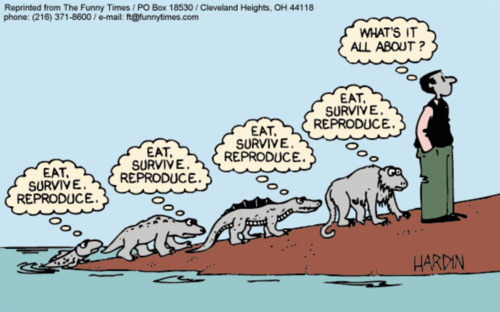
You are created to reproduce. This is a statement of biological fact. You can like it or not. But it is there at our core. No tribe in the Amazon has ever entertained the idea of "antinatalism." We will reproduce no matter what. You can either contribute to the future by raising children and instilling in them the values of compassion, decorum, humility, curiosity, freedom of conscience, and the like. Or you can let the world get populated by Jihadists, Amish, Mennonites, Mormons, and all the other weird rapidly-expanding subsets of our species while standing on the side and let them change the future in a direction that is very much for the worse.
For better or worse, philosophy exists on a backdrop of millions of years of evolutionary drives. Do we choose to reject these instincts entirely or do we choose to wield them and use philosophy to moderate their excesses and unite them with wisdom? I would say the latter is our only real choice, because if we try to do a battle between philosophy and evolution, evolution will always win. The antinatalist himself is as much a slave to evolution as anyone else. The "empathy" and "concern" he feels for all the suffering creatures on earth is itself an evolutionary capability designed to help him identify and collaborate with other hominids. Ethics that is not ultimately designed to help us eat, survive, and reproduce as a species will be doomed, because we will never transcend evolution. Evolution is the unfolding and appropriation of being itself.
Realistically, you will never convince everyone to stop having kids. And the small minority who refuse to stop having kids will not remain small for long. And yet, the antinatalists are very correct in that they recognize that the Earth's resources are being strained and that the Earth is overpopulated. A lot of well-educated people in the first world refusing to have children will just mean that they will be quickly outbred and replaced by a bunch of sub-Saharan Africans and South Asians. They will have no impact whatsoever unless they resort to violent means, which I think all of them rightly reject.
What do we do, then? The answer is one that no one likes: population control. I don't like to admit it. I don't want to live in a world where a global government puts restrictions on who can reproduce and why. I don't trust any authority to wield this power in a truly dispassionate way. The issues of which religions, races, languages, etc. "deserve" to have more or less people will be very hard. A lot of us have instinctive fears over the idea of a global government, but it's potentially possible that a global government could be a lot less oppressive than small-scale local ones. It's perfectly possible for a country to be totalitarian even without a large scope. North Korea anyone? Some have written about the idea of parental licenses as a potential fix.
I don't like this idea. But I think it might be the only possible fix. And it might seem less and less radical and evil as competition for resources becomes more extreme. And it is certainly less radical than the antinatalist who wants us to just pull the plug on the whole human experiment. The antinatalist can simply cloak his argument in more compassionate language so he doesn't tick the same alarm bells as the idea of something like a parental license. But his ideology is far more radical and hard to accept at its core.
As the last part of this argument, I want to call attention to the supposed historical examples of antinatalist thinking that antinatalists like to point to as giving their thought a sound historical precedent. Note that this is not in and of itself a killshot argument against the philosophy. Historical foundations for string theory are also lacking, but it doesn't make it less true. But this annoys me and I feel like it's a point I've never seen anyone attack antinatalists on.
Many antinatalists will cite examples from the ancient world like the following choral ode from Oedipus at Colonus by Sophocles:
Not to be born is, beyond all estimation, best; but when a man has seen the light of day, this is next best by far, that with utmost speed he should go back from where he came. For when he has seen youth go by, with its easy merry-making, what hard affliction is foreign to him, what suffering does he not know? Envy, factions, strife, battles, and murders. Last of all falls to his lot old age, blamed, weak, unsociable, friendless, wherein dwells every misery among miseries.
Sophocles, Oedipus at Colonus 1225-1235 [19]
Or the following verses of lamentation from the book of Job:
Why died I not from the womb? Why did I not give up the ghost when I came out of the belly? Why did the knees prevent me? Or why the breasts that I should suck? For now should I have lain still and been quiet, I should have slept: then had I been at rest, with kings and counsellors of the earth. which build desolate places for themselves; or with princes that had gold, who filled their houses with silver: or as an hidden untimely birth I had not been; as infants which never saw light. There the wicked cease from troubling; and there the weary be at rest. There the prisoners rest together; they here not the voice of the oppressor. The small and great are there; and the servant is free from his master.
Job 3:11-19 [20]
To me, these seem like emotive expressions more than strict logical argument. It would be hasty to say that Sophocles and Job should not be read "philosophically" because they do not necessarily fall into our modern categories of "philosophy." These categories were far less distinct in ancient times. But the general mode of expression for philosophical thought was far less scientific and far more poetic. This means far less "literal." So I do believe that a straightforward reading of these as expressions of antinatalist thought is mistaken. I do not necessarily want to critique philosophers for using quotes slightly out of context to make them appear in provocative, novel ways. I do it all the time! But I don't want people to get a distorted impression of how widespread this extremely fringe ideology really is.
I should also talk about Buddhism, because many say that it is the most truly antinatalist religion. I've also claimed to be something of a lay Buddhist (at least to the degree that I go to a Buddhist temple regularly), so I would seem to be not following my own religion's dictates. Buddhism is indeed a religion which claims that life is inherently dissatisfactory and that the goal is to end the cycle of reincarnation. How could it not be antinatalist then?
For one thing, if we view the historical reality of the religion as it is practiced as at all relevant for its definition, which does not seem unreasonable to me, we cannot think of Buddhism as antinatalist at all. Why? Because it still exists! Any truly "antinatalist" religion would die out in a few generations. Any truly "antinatalist" tendencies in the religion were clearly moderated. You can find extreme tendencies against procreation in some early Christian sects as well, but because Christianity by and large did not make this central to its doctrine, it seems disingenuous to call it truly antinatalist.
But maybe that's not convincing enough. Maybe all those who are "Buddhist" but who are still procreating are just not living up to the full demands of the religion. I disagree here as well. In Buddhist scriptures, nirvana is explicitly described as "neither-existence-nor-non-existence." Well, that's pretty clear. The goal is explicitly NOT non-existence. The fact that it is spoken of in primarily apophatic terms does not mean that it is a pure negation at is core. Indeed, it is described as beyond all conventional designations of life and death, cause and effect, and even existence and non-existence. Given that one must be a human to enter into nirvana according to Buddhism, I believe that the ultimate goal is that it is better that beings came into existence even with an infinite series of past lives full of suffering. Nirvana is just that good!
So far I have assessed antinatalism as a philosophy and attempted to avoid "ad hominem" attacks. Antinatalists often complain of being psychologized instead of legitimately argued against, as if all their philosophical insights could be explained away by merely seeing them as having a mood disorder. I don't think that doing so is enough to reject their arguments, which is why I have dedicated all of the above to doing so on a philosophical basis. But I do think that doing a psychological study on what makes someone an antinatalist can give some insights that are more informative than other philosophical systems. None of this might immediately be enough to discount the arguments, but I think it helps to get a picture of why they often seem so zealously attached to their beliefs and seemingly incapable of being moved.
Technically one could be an antinatalist without experiencing the depths of depression and anhedonia. But it certainly would make sense for insights of antinatalism to seem much more potent with mood imbalances than not. The relative weight that bad things in life could have compared to the good may just seem more extreme than they really are as a kind of optical illusion of value. Benatar has responded to this by saying that there are plenty of manic people and that their experience of the world might also be colored by their happiness. But this isn't a refutation of that accusation. There is no value independent of us humans. There is no uncolored lens to look through. If Benatar has reason to reject manic people's evaluation of life as biased, we can reject his as well. We can only appeal to intersubjective standards of how good or bad life is, and if it's a pure democratic vote Benatar is in the overwhelming minority.
So why are people drawn to antinatalism? Why is there an admittedly still quite small but rapidly-growing online following for it? Why do people fawn over David Benatar, who is by all accounts the kind of academic nerd philosopher who would never gain a cult following if he didn't entertain this radical position? Because antinatalism is a philosophy that FEELS like good medicine for people who are depressed or hopeless. It feels like a justification of peoples' pessimism, compassion and/or misanthropy, and anhedonia. Not all antinatalists are suicidal and very few advocate for it, but antinatalism is the logic of suicide: An easy way out. A rejection to keep trying. It strikes me as something close to a form of philosophical self-harm.
While antinatalists try to put forward a "selfless" face, many probably adopt the ideology as a form of virtue-signalling that is ultimately self-serving. What's the best way to one-up a vegan? Say that not only do you mourn all those animals in factory farms, but you mourn all the animals in nature being killed as well. Say that not only do you wish humans would stop farming animals, but that you wish they would all stop breeding as a kind of collective martyrdom. And somehow, miraculously, the philosophy justifies you sitting on your ass playing video games and posting on /r/antinatalism all day (i.e. what you were already doing) as the most morally virtuous action. Can't find a girlfriend? Don't worry, now you can cope by reframing that as being an act of sacrifice on behalf of all sentient creatures.
Want some evidence? Well, I don't want to judge all antinatalists by the posters on /r/antinatalism, because Reddit is in general a cesspit for the worst of humanity and an embarrassment to any ideology. But I believe it is instructive in this case. A study of subreddits with the most overlap to /r/antinatalism shows /r/mgtow and /r/lonely quite high on the list (remember what I said about reframing your inability to find a partner?), along with /r/antiwork, /r/lostgeneration, /r/collapse, /r/suicidewatch, /r/depression, /r/noahgettheboat, /r/latestagecapitalism, and others that don't exactly inspire confidence in these people having a worldview that is "uncolored" by negative mental states. It makes you wonder whether it really is the pure logical consistency that draws people to antinatalism.
There's clearly also an element of rebellion involved in it. The above data shows /r/exchristian, /r/exmuslim, /r/exjw, /r/raisedbynarcissists, and /r/insaneparents as all quite high. Let's admit it, if you were raised in a fundamentalist faith that encourages you to procreate at all costs, there's no better way to rebel than not only rejecting the values of your parents, but THOUSANDS OF YEARS OF YOUR ANCESTORS as well! It's rebelling against the most fundamental thing we are "supposed" to do for our parents. Now, having a rebellious phase is by no means all bad. It's very necessary for development for teens and young adults to be critical about what they were brought up with and have the cognitive flexibility to think in the opposite direction. But too many people become entirely defined in opposition, which is really still just being controlled by it. Some of this is sustained by the so-called "pro-life" movement in the US being a bunch of insane theocrats, so those who want to oppose it are often skeptical of anything that could sort of sound like "pro-life" talking points. So they go in the complete opposite direction and entrench themselves in an extreme position like antinatalism. Sad, but a common story.
Let's think about what might be to your advantage if you were the CEO of a fossil fuel company. It's becoming increasingly hard to bribe fake scientists to go spread doubt about global heating and about greenhouse gas emissions from humans being the cause of it. It's just out of the bag at this point. So you're trying to attack it from other angles. You try to say that oil is a more reliable and stable fuel source, but it's hard to get people to believe that when one country led by a bunch of theocratic maniacs can close the Strait of Hormuz and fuck up oil prices for half the planet. So how about you just find a way to convince people that it would actually be in their best interests to go extinct? They might oppose your developments in theory, but can they really muster much energy when their endgame is extinction to begin with?
What if you were one of those weird technocrats in Silicon Valley who wants the entire workforce to be replaced with AI but not to share any of the profits with the rest of the planet? What would be a great way to ensure that you could go down the road of phasing out the rest of the human population while investing into technologies to help you prolong your lifespan so you can be sure to play the long game? What could be a better ideology to spread than one that made it seem all the more ethical to replace human beings with non-conscious LLMs? How great it would be if the anti-human future you dreamed of was accepted by a pacified populace who would be happy to see themselves dwindle out?
I am making no accusations about platforms pushing antinatalist messages. But I am just saying that CERTAIN people could benefit immensely from these messages being widespread (and not just Jihadists).
If the act of procreation were neither the outcome of a desire nor accompanied by feelings of pleasure, but a matter to be decided on the basis of purely rational considerations, is it likely the human race would still exist? Would each of us not rather have felt so much pity for the coming generation as to prefer to spare it the burden of existence, or at least not wish to take it upon himself to impose that burden upon it in cold blood?
Arthur Schopenhauer, "On the Suffering of the World" [21]
Arthur Schopenhauer believed that humans are pushed along by a will which is blind, hungry, and irrational. It pushes us on to feature all the pain involved in love and heartbreak and, of course, to reproduce more of us. Schopenhauer saw our existence as fundamentally tragic: We are capable of reason but the will keeps us bound to vulgar, earthly desires that keep us from attaining real wisdom and virtue. I would say that Schopenhauer is almost totally correct, but I view the will as an absolute blessing rather than a curse. With nothing but reason, there is no vitality in life. There is only existence and never becoming. It is only via the will that the dead letters of reason become animated and there is any beauty or goodness in the universe. Reason and the will must come into conflict at times, but this dynamic tension is a process that creates everything grand. And I think it would be a great tragedy if procreation, like other acts of love, was reduced to mere "reason."
O goodness infinite, goodness immense!
That all this good of evil shall produce,
And evil turn to good; more wonderful
Then that which by creation first brought forth
Light out of darkness! full of doubt I stand,
Whether I should repent me now of sin
By mee done and occasiond, or rejoyce
Much more, that much more good thereof shall spring.
John Milton, Paradise Lost, Book 12, lines 469-476 [22]
Although there are lots of darknesses, it is a miracle that there are things instead of nothing.
Let's praise for that.
Thricegreat, "Thank For Existence" [23]
There is a concept in Christian theology called the "Fortunate Fall," which evolved out of a particularly difficult problem in the Christian worldview: The Christians have to make sense of a world where god created paradise on Earth and peopled it with Adam and Eve. Then he allowed them to sin and be expelled into all the miseries of our earthly existence. And yet, we are supposed to believe that this god has boundless, infinite love for us. Why then did god not simply leave us in the garden? It had to be concluded that it was in fact better to have that goodness emerge out of evil than to have a pure, neutral state of eternal goodness.
I can barely conceive a type of beauty in which there is no melancholy.
Charles Baudelaire [24]
The Christian perspective sounds absurd. But I would actually say that there is something to the idea of the fortunate fall. Why? Because it is only because we have been doomed to have non-perfect lives that there is love, beauty, virtue, and everything else of value. The greatness of existence is precisely in its chance, transience, and fragility. Becoming is more excellent than static existence. The antinatalist would want to engineer cherry blossoms to last all year long. But everything wonderful about cherry blossoms would be lost if they were not so short and ephemeral. We are very fortunate to have the kind of existence that allows us to live in a world that allows for such complex, refined sources of beauty. And I do in fact believe that these are far superior to non-existence.
Ah, these are the days
Let them roll as they roll
And be all you are
Because you're beautiful
Material
Devin Townsend, "Material" [25]
In the end, the antinatalist will certainly win. Humans will go extinct at some point. If the Earth crashing into the sun doesn't kill us because we've become a multi-planet species, something else will. But it is precisely for the great uncertainty and chance at the heart of existence that there can be joy and beauty and everything valuable. Everything good rests on the original Nothing. We must live beautiful, excellent lives for the very reason of their seldomness. And part of that, dictated to us by every primordial source of wisdom including our biological instincts, involves the creation of new sources of wisdom, new lives, new conscious folds in the emerging fabric of the universe, who will require us as ancestors in ways we do not yet have the ability to fathom. I do not know how else to conceive of goodness than as something to be shared through a relation between real, existing others. And without real, existent others after us, goodness will die. If this is an irrationality and an immorality, it is one I will take with me to my grave as I pass into the vast ocean of the source.
1. Arthur Schopenhauer [trans. R.J. Hollingdale], Essays and Aphorisms, "On the Suffering of the World," Penguin Books, 1973, p. 34
2. David Benatar, Better Never to Have Been: The Harm of Coming Into Existence, Oxford University Press, 2006
3. Sam Harris & David Benatar, Making Sense #107: "Is Life Actually Worth Living?", SamHarris.org, 2017/12/05
4. Ibid.
5. Todd May, Should We Go Extinct?: A Philosophical Dilemma for Our Unbearable Times, Crown New York, 2024, p. 25-26
6. David Wasserman, Debating Procreation: Is It Wrong to Reproduce?, Oxford University Press, 2015, p. 162-163
7. Ibid., p. 161
8. The Simpsons - lesson is, never try
9. David Wasserman, Debating Procreation: Is It Wrong to Reproduce?, Oxford University Press, 2015, p. 174
10. Ibid., p. 171
11. Arthur Schopenhauer [trans. R.J. Hollingdale], Essays and Aphorisms, "On the Suffering of the World," Penguin Books, 1973, p. 34-35
12. Luke Smith, "The Problems With Utilitarianism"
13.Joshua Greene, "The Terrible, Horrible, No Good, Very Bad Truth About Morality and What to Do About It," dissertation at Princeton University, p. 331-332
14. Martin Heidegger [trans. William Lovitt] [ed. David Farrell Krell], Basic Writings: Ten Key Essays, Plus the Introduction to Being and Time, HarperPerennial, 2008, p. 333
15. Ibid.
16. Todd May, Should We Go Extinct?: A Philosophical Dilemma for Our Unbearable Times, Crown New York, 2024, p. 24-25
17. David Wasserman, Debating Procreation: Is It Wrong to Reproduce?, Oxford University Press, 2015, p. 163
18. Morioka Masahiro, What Is Antinatalism? and Other Essays: Philosophy of Life in Contemporary Society, Tokyo Philosophy Project, 2021, p. 90-93
19. Sophocles [trans. Sir Richard Jebb], Oedipus at Colonus 1225-1235, Perseus Digital Library
20. Job 3:11-19, BibleGateway, King James Version
21. Arthur Schopenhauer [trans. R.J. Hollingdale], Essays and Aphorisms, "On the Suffering of the World," Penguin Books, 1973, p. 38
22. John Milton, Paradise Lost, Book 12, lines 469-476, The John Milton Reading Room, Dartmouth College
23. Thricegreat, Thank For Existence.
24. Charles Baudelaire, Goodreads
25. Devin Townsend, Devin Townsend - Physicist - Encyclopaedia Metallum: The Metal Archives